
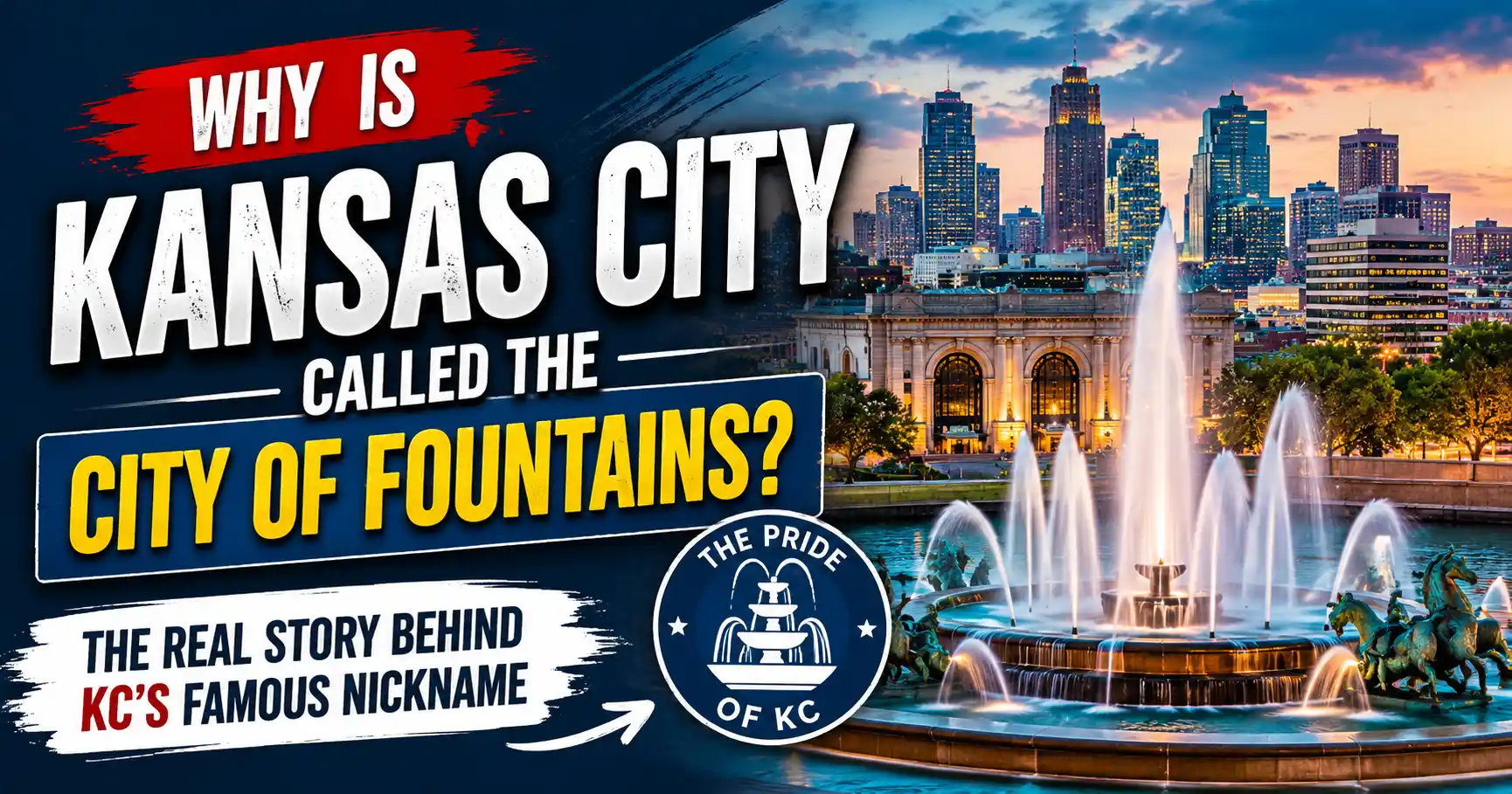
Hello, and welcome to the story behind one of America’s most charming city nicknames. If you’ve ever visited Kansas City, Missouri, you probably noticed something special right away: beautiful fountains are everywhere. They splash in front of office buildings, dance in quiet parks, and greet you along tree-lined boulevards. It feels like the city was built around water. That’s exactly why people started asking, “Why is Kansas City called the City of Fountains?” The answer is a mix of practical problem-solving, artistic vision, and a whole lot of civic pride. Let me walk you through it.
💧 Quick Answer
Kansas City earned the nickname “City of Fountains” because it has more publicly maintained fountains than any city in the world except Rome. What began with a single horse-and-dog drinking fountain in 1899 grew into a citywide love affair with decorative water features. By the 1970s, civic leaders and tourism boosters officially embraced the title, and today over 200 unique fountains splash across the metro.
The nickname isn’t just a marketing slogan. It’s a piece of living history you can see, hear, and feel on almost every block.
What Does “City of Fountains” Mean?
At its simplest, calling Kansas City the “City of Fountains” means it’s famous for having an unusually large number of beautiful, working fountains in public spaces. But the phrase carries a deeper meaning, too. It represents the city’s long-standing commitment to public art, green spaces, and making everyday life a little more beautiful.
Many of the fountains tell a story—about the people who built Kansas City, the neighborhoods that shaped it, and the dream of turning a dusty Midwestern town into an elegant, European-inspired metropolis. When you hear the nickname, think of it as shorthand for a city that decided water and art belong to everyone.
Why Is Kansas City Called the City of Fountains?
So where did this nickname actually come from? The full explanation weaves together history, culture, and a bit of good timing. Kansas City didn’t set out to become a fountain capital. It happened because people cared about solving a practical problem, then fell in love with the beauty those solutions created.
A Humble Beginning: Water for Horses and Dogs
In the late 1800s, Kansas City’s streets were filled with horse-drawn wagons. On hot summer days, the animals needed fresh drinking water. The city’s first public fountain wasn’t built to be pretty—it was built to be useful. The Humane Society of Kansas City installed a stone drinking fountain at 3rd Street and Minnesota Avenue for horses, dogs, and people. It was purely functional, but it planted an idea: public water features could serve everyone.
Then, in 1899, the same organization placed a more decorative fountain at 9th Street and The Paseo. That fountain still runs today and is known as the Women’s Leadership Fountain. According to Kansas City Parks and Recreation, it is the oldest continuously operating public fountain in the city. People loved seeing fresh water dance in the middle of a growing town. It felt elegant and neighborly at the same time.
City Beautiful and Country Club Plaza
The early 1900s brought the City Beautiful movement to America. City planners and architects believed that attractive public spaces made better communities. Kansas City embraced this wholeheartedly. The parks and boulevard system, designed by landscape architect George Kessler, called for ornamental fountains as focal points.
Then came J.C. Nichols and his vision for the Country Club Plaza in the 1920s. Nichols wanted to create a shopping district that looked like the beautiful plazas of Spain and Italy. What did those places have? Fountains, of course. The Plaza area was soon dotted with stunning European-style fountains, complete with tile work, sculptures, and dramatic nighttime lighting. Visitors and locals alike began to associate Kansas City with these wonderful water displays. Though nobody shouted “let’s call it the City of Fountains!” overnight, the nickname started naturally bubbling up in conversation and news articles.
A Title Becomes Official
For decades, people casually called Kansas City the “City of Fountains.” But in the early 1970s, two enthusiastic fountain lovers named Harold and Peggy Rice decided the nickname deserved formal recognition. They founded the City of Fountains Foundation in 1973 to protect, restore, and celebrate the city’s fountains. Around the same time, tourism promoters began leaning into the catchy title. Maps, brochures, and slogans started proudly declaring Kansas City the “City of Fountains,” and the nickname stuck for good.
Origin of the Nickname
Unlike nicknames coined by a single newspaper reporter or author, “City of Fountains” grew slowly from the city’s landscape itself. The earliest references appeared in local travel writing and chamber of commerce materials around the middle of the 20th century. Kansas City’s public library archives hold postcards from the 1940s and 1950s that refer to the “famed fountains of Kansas City,” though they don’t yet use the exact phrase “City of Fountains” as a proper name. By the 1960s, the phrase appears more consistently in tourism ads.
The shift from description to official nickname probably happened between the 1960s and 1970s. The founding of the City of Fountains Foundation in 1973 marks a clear turning point. After that, the city’s government and visitor bureaus adopted the term as an identity, not just a compliment.
Who Coined the Nickname?
This is a question historians get a lot, and the honest answer is: nobody knows for sure. There is no single person, newspaper, or event credited with inventing the phrase “City of Fountains.” Instead, the name arose organically, much like a neighborhood gets a friendly nickname over time. What we do know is that Harold and Peggy Rice popularized and formalized it through the foundation. Before them, various local writers and boosters had already described Kansas City as a “city of fountains.” The Rices simply gave the existing phrase an official home.
The City of Fountains Foundation itself doesn’t claim to have invented the nickname. It aims to preserve what the community had already lovingly built. So while we can’t point to one person and say, “They thought of it!” we can appreciate how a whole city embraced a beautiful idea.
History Behind the Nickname
Understanding the history behind the nickname means walking through Kansas City’s changing attitude toward public spaces. In the late 19th century, fountains were practical. By the early 20th century, they became symbols of culture and sophistication. The Country Club Plaza fountains, inspired by places like Seville’s Plaza de España, made Kansas Citians feel connected to European art. After World War II, suburban growth brought even more fountains to shopping centers, corporate parks, and hospital gardens.
A fascinating turning point came in the 1960s and 1970s when preservation became a priority. As some older fountains fell into disrepair, concerned citizens stepped up. The City of Fountains Foundation rallied volunteers and raised money to keep every fountain flowing. Local businesses joined in, realizing that tourists genuinely came to see the fountains. Today, the city maintains an official inventory of over 200 fountains, and each year new ones are added.
According to Visit KC, Kansas City truly embraced the “City of Fountains” identity as a way to differentiate itself from its larger Midwestern neighbors. It wasn’t just about having water features—it was about telling the world that Kansas City valued beauty, community, and a touch of romance.
How the Nickname Became Popular
The nickname spread in exactly the way you’d hope a city’s identity would—through everyday pride. Local newspapers ran photo essays of the fountains. Hotel concierges recommended fountain tours. Families brought out-of-town guests to pose next to the grandest basins and sculptures. In the 1970s and 1980s, Visit KC (then the Convention and Visitors Bureau) placed the “City of Fountains” phrase on everything from bumper stickers to national ad campaigns.
Events helped, too. The annual Plaza Art Fair, seasonal fountain lighting ceremonies, and even the Royals’ 2015 World Series victory parade (which wound past several famous fountains) reinforced the image. Television travel shows and social media did the rest. Now when you search “Kansas City,” you’ll see fountain photos almost immediately.
Myths vs Facts
People love to share fountain stories. Some are true. Some are, well, a little shaky. Let’s clear up the most common ones.
Is the Nickname Still Used Today?
Absolutely. Walk into any Kansas City gift shop and you’ll find the phrase on T‑shirts, mugs, and magnets. The city’s official tourism site, Visit KC, actively promotes fountain‑focused itineraries. City Hall proudly includes fountain imagery in public art installations. Locals might not say it out loud every day, but they feel a deep connection to it. When someone asks a Kansas Citian what makes their hometown special, “We’re the City of Fountains” is almost always part of the answer.
Cultural Impact
The nickname has shaped how Kansas City sees itself and how the world sees Kansas City. It gives the city a softer, more artistic identity, balancing out its jazz, barbecue, and sports reputations. Movies and TV shows set in KC often use fountains as visual shorthand for romance and beauty. The Kemper Museum of Contemporary Art and the Nelson‑Atkins Museum of Art both feature prominent fountains that appear in countless engagement photos and Instagram posts.
Musicians have referenced the fountains, too. Local bands occasionally name‑check them, and big events like the Fountain Day celebration—when the city’s water features are turned on each spring—draw crowds every year. The nickname is woven into the civic fabric, influencing public art funding, park design, and even neighborhood identities.
Interesting Facts
- The oldest working fountain, the Women’s Leadership Fountain, has survived two world wars, a Great Depression, and multiple renovations—still flowing strong.
- Kansas City’s fountains range from tiny hidden gems in residential gardens to the massive, 322-foot-long J.C. Nichols Memorial Fountain near the Plaza.
- The City of Fountains Foundation once saved the 47th Street fountain, which was built in 1927, from demolition after a car accident—fundraising brought it back to life.
- Every April, the city officially turns on the fountains with a ceremony that locals treat like a spring holiday.
- Fountains appear on Kansas City’s street signs and welcome markers as part of the official city identity.
- In 2023, a new fountain was installed at the Kansas City International Airport terminal, greeting travelers with the nickname before they even leave the airport.
- Some fountains double as splash pads for kids during hot summer afternoons; they’re built for beauty and fun.
Other Nicknames of Kansas City
The “City of Fountains” is certainly the most famous, but Kansas City answers to several other names. You might hear it called the “Heart of America,” “KC,” or “Paris of the Plains.” Each one has its own story. If you’re curious about how those came to be, I’d love for you to check out the full guide at Kansas City Nicknames.
Related City Nicknames
Many U.S. cities are known for one remarkable feature that defines them, just like Kansas City’s fountains. Here are a few you might enjoy exploring.
How “City of Fountains” Compares to Another Famous Nickname: Windy City
You’ve probably heard Chicago called the “Windy City.” It’s interesting to put these two nicknames side by side, because one is literal and the other is a bit of a trick.
⛲ City of Fountains (Kansas City)
- Based on a real, visible feature: over 200 fountains.
- Nickname grew from community beautification efforts.
- Official identity embraced by tourism and government.
- Makes people think of art, romance, and public spaces.
💨 Windy City (Chicago)
- Not about the weather—originally referred to talkative politicians and boastful city promoters.
- Popularized by 19th-century newspaper rivalries.
- Now a playful, widely recognized nickname.
- Makes people think of resilience, energy, and history.
If you love comparing how cities get their identities, check out the full story of the Windy City and others in our Famous City Nicknames collection.
Frequently Asked Questions
❓ Why is Kansas City called the City of Fountains?
Because it maintains more publicly accessible decorative fountains than any other U.S. city and ranks second worldwide only to Rome. The tradition started with a horse drinking fountain in the 1890s and grew into a city-defining art form.
❓ What does the nickname “City of Fountains” mean?
It means Kansas City is identified and celebrated for its extraordinary collection of over 200 fountains. It’s a literal description and a symbol of the city’s commitment to public beauty and water features.
❓ Who coined the nickname City of Fountains?
No single person can be credited with inventing it. The nickname developed gradually through local usage. Harold and Peggy Rice, who founded the City of Fountains Foundation in 1973, are widely credited with formalizing and popularizing the term.
❓ Is City of Fountains an official nickname?
Yes. While not a legal designation, the city government, parks department, and official tourism agency (Visit KC) all embrace and actively use the nickname. It appears on city signs, airport art, and marketing materials.
❓ Do locals still use the nickname today?
Absolutely. You’ll hear it in conversations, see it on local merchandise, and find it heavily promoted during events. Most Kansas Citians take real pride in the title and will happily tell visitors about their favorite fountains.
❓ How many fountains does Kansas City really have?
The official count maintained by Kansas City Parks and Recreation exceeds 200 publicly owned and operated fountains. That doesn’t even include private fountains in gardens, plazas, and corporate campuses.
❓ What are other nicknames for Kansas City?
Besides City of Fountains, Kansas City is also known as the “Heart of America,” “Paris of the Plains,” and simply “KC.” Each nickname highlights a different part of the city’s geography, history, or culture.
❓ Why is Kansas City famous for fountains?
It’s the combination of sheer quantity, artistic variety, and historical depth. From a simple 1899 watering trough to world‑class sculptures, Kansas City invested in fountains for over a century, creating a collection unlike anywhere else in the country.
❓ Is the nickname historically accurate?
Yes, in the sense that Kansas City does possess an exceptional concentration of public fountains, carefully documented and maintained. The claim of being second only to Rome in number of working fountains is also well-supported by fountain organizations and civic records.
Explore More City Nicknames
If you enjoyed discovering why Kansas City became the City of Fountains, there’s a whole world of fascinating city nickname stories waiting for you.
🎨 Kansas City Nicknames
The complete guide to every KC nickname and what they mean.
Explore KC nicknames →📍 Missouri City Nicknames
Discover how other Missouri cities earned their colorful nicknames.
Browse Missouri nicknames →🌟 Famous City Nicknames
The stories behind America’s most iconic city nicknames.
See famous nicknames →Conclusion
Kansas City didn’t become the City of Fountains by accident. It happened because generation after generation of Kansas Citians decided that water, art, and public space mattered. That first humble horse trough started a tradition that now defines an entire metropolitan area. The next time you’re standing in front of a fountain on the Plaza, or stopping to watch water dance in a quiet park, you’ll know exactly why is Kansas City called the City of Fountains. It’s not just about the number. It’s about the heart behind every drop.
Sources & References
- Kansas City Parks and Recreation — Fountains in Kansas City
https://kcparks.org/fountains/ - Visit KC — City of Fountains
https://www.visitkc.com/ - Kansas City Public Library — Kansas City Fountains (Missouri Valley Special Collections)
https://kchistory.org/ - City of Fountains Foundation — About the Foundation
https://www.kcfountains.org/ - Kansas City Star Archives — Fountain Day coverage and historical features (available through library databases)
- Kansas City, Missouri Official Website — Public Art and Fountains
https://www.kcmo.gov/