If you want to know about “Why Is Seattle Called the Emerald City?” Here is a Ans below
Quick Facts Table
| Fact | Detail |
|---|---|
| City | Seattle |
| State / Country | Washington, United States |
| Nickname | The Emerald City |
| Meaning | An emerald‑green jewel city, honoring the region’s dense, evergreen forests that stay vivid all year |
| First Known Usage | 1982 (contest announcement) |
| Popularized By | Seattle‑King County Convention & Visitors Bureau (now Visit Seattle) |
| Known For | Evergreen forests, rain, Space Needle, coffee culture, tech hubs, the Seahawks’ green |
What Does “Emerald City” Mean?
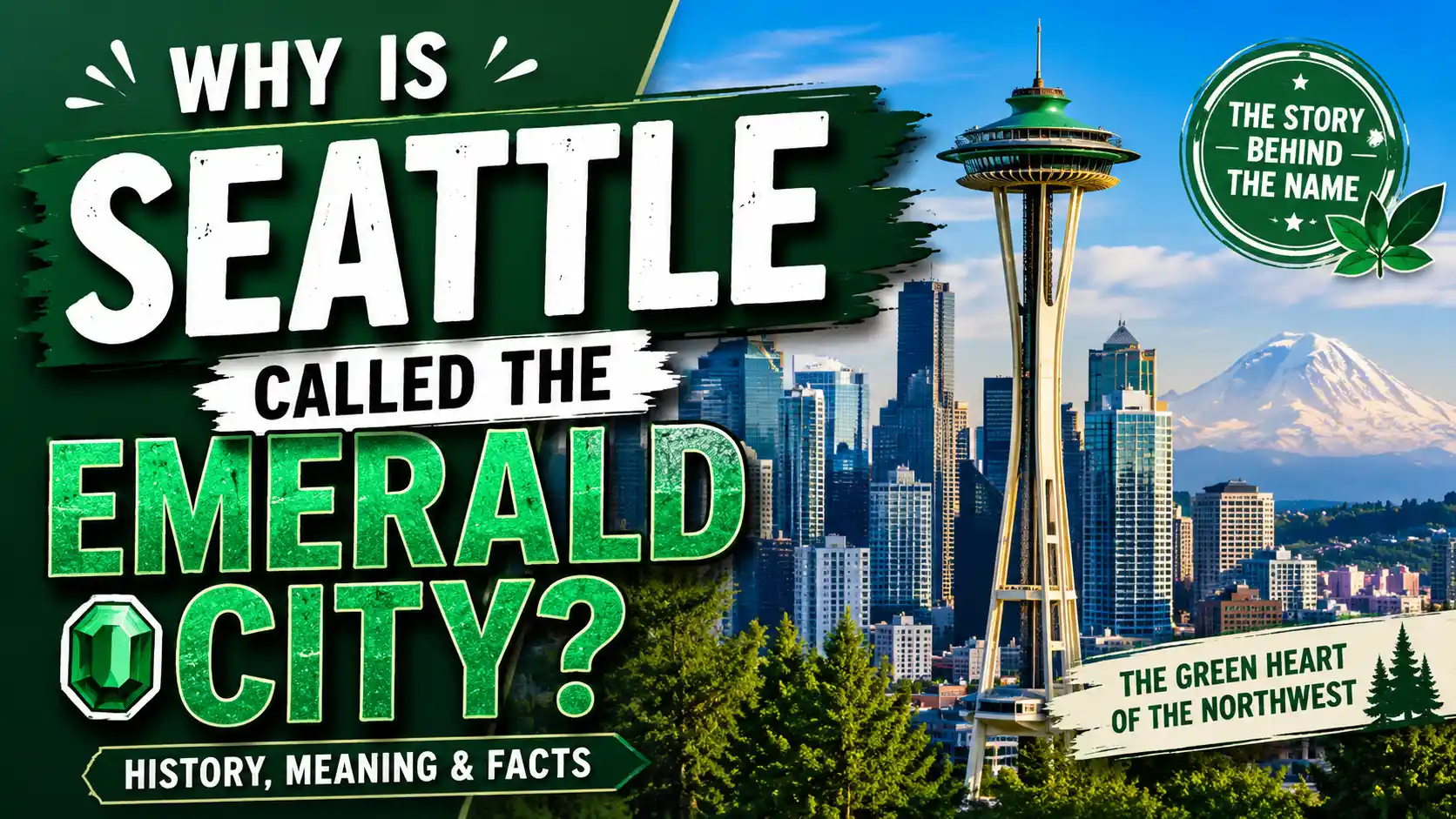
An emerald is a brilliant green gemstone, and “Emerald City” paints Seattle as a treasure carved from living green. The name doesn’t refer to actual precious stones, but to the way the city and its surroundings remain blanketed in deep, rich greens. Walking through Seattle’s neighborhoods or flying over Puget Sound, you see dense carpets of Douglas fir, western red cedar, and western hemlock that refuse to fade even in mid‑December. The nickname is a metaphor: Seattle looks like a shining emerald set against the gray Pacific Northwest sky. It’s a badge of natural beauty and a promise that the city is alive and vibrant no matter the season.
Why Is Seattle Called the Emerald City?
The complete answer sits at the intersection of geography, civic pride, and a clever tourism campaign. Seattle occupies a narrow strip of land between the saltwater of Puget Sound and the freshwater of Lake Washington, in a region where a mild marine climate and steady moisture create a natural greenhouse. Before the contest, the city already leaned on “green” for its identity — but it needed a moniker that felt fresh, distinctive, and unshakably local. The 1982 contest delivered exactly that.
However, the deeper “why” goes beyond the contest. The nickname stuck because it matched something residents already sensed: the evergreens define Seattle’s character. Rain scrubs the air, moss drapes over branches, and even urban parks like Discovery Park and the Washington Park Arboretum overflow with ferns and towering conifers. When the tourist bureau started printing “Seattle: The Emerald City” on brochures, travelers instantly understood the reference. The nickname answered the question, “What does Seattle look like?” in one vivid, jewel‑toned word.
The Origin of the Nickname
Before the 1980s, Seattle’s go‑to nickname was “Queen City.” That title, dating to the late 1860s, was originally “Queen City of the Northwest,” meant to position Seattle as the cultural and economic capital of the region. The trouble: several other U.S. cities — including Cincinnati, Ohio, and Charlotte, North Carolina — also claimed “Queen City” status. By the late 20th century, Seattle’s tourism and business leaders wanted a name nobody could confuse with another place.
Meanwhile, Boeing’s postwar boom had given rise to the informal “Jet City” (after the jetliners assembled in the area), but that nickname tied Seattle to a single industry. When the economy slumped in the early 1970s, the moniker lost some of its shine. The convention and visitors bureau decided the city needed a nickname that was timeless, rooted in the natural environment, and completely its own.
In the fall of 1981, the bureau launched a public “Name the City” contest. Entries poured in from thousands of residents. Judges sorted through suggestions ranging from “Rain City” and “Evergreen City” to “Sea‑Town” and “Gateway to Alaska.” The winner, “Emerald City,” captured the region’s most visible trait — its almost impossibly green landscape — in a way that felt elegant and marketable.
Who Coined the Nickname?
The winning entry was submitted by Sarah M. Clark, a Seattle real estate agent who lived in the Madison Park neighborhood. Clark’s “Emerald City” suggestion beat out more than 5,000 other proposals. She was awarded a prize that included a weekend getaway and a savings bond — a modest reward for a name that would echo around the globe.
There is no credible evidence of widespread use of “Emerald City” for Seattle before Clark’s contest submission. A few tourism slogans may have experimented with the phrase in the late 1970s, but the 1982 contest is universally recognized as the official birthplace of the nickname and Clark as its creator.
History Behind the Nickname
To understand how “Emerald City” took root, it helps to see the bigger timeline of Seattle’s nicknames:
- 1851: The Denny Party settles at Alki Point, briefly calling the spot “New York Alki” — Chinook jargon for “New York someday.”
- 1869: Seattle incorporates and begins promoting itself as the “Queen City of the Northwest,” a title that sticks for more than a century.
- Post‑WWII: “Jet City” emerges as Boeing’s commercial jetliners make Seattle a global aviation capital.
- 1962: The Century 21 Exposition (the World’s Fair) gives Seattle the Space Needle and the Monorail, raising the city’s profile but not its permanent nickname.
- Late 1970s–1981: Economic diversification and the growth of tech and outdoor recreation create a sense that Seattle needs a fresh, environment‑forward brand.
- 1982: The “Emerald City” contest winner is announced. The tourism bureau immediately incorporates the nickname into ads, visitor guides, and a new emerald‑green logo.
The nickname landed at the perfect cultural moment. The environmental movement was strong in the Pacific Northwest, and Seattle was marketing itself as a gateway to the mountains, forests, and waterways of Washington State. Saying “Emerald City” on a poster felt like a breath of fresh, pine‑scented air.
Timeline of the Nickname
| Year | Event |
|---|---|
| 1851 | Seattle founded; briefly called “New York Alki” |
| 1869 | “Queen City of the Northwest” becomes the dominant nickname |
| 1940s–1960s | “Jet City” gains popularity alongside Boeing’s rise |
| 1962 | Century 21 Exposition puts Seattle on the map, Space Needle opens |
| Fall 1981 | Seattle‑King County CVB launches a city nickname contest |
| 1982 | “Emerald City” announced as winning entry; Sarah M. Clark credited |
| 1982–1990 | CVB uses the nickname heavily in national and international advertising |
| 1990 | Seattle adopts its official city flag, featuring a teal‑green background |
| 2003 | Emerald City Comic Con is founded, eventually drawing over 100,000 fans |
| 2010s–present | “Emerald City” firmly cemented in tourism, sports, and local business names |
How the Nickname Became Popular
The nickname didn’t achieve its near‑universal status overnight; it was deliberately cultivated and then organically embraced.
- Tourism marketing: Immediately after the contest, Visit Seattle (then the CVB) plastered “Seattle: The Emerald City” on everything from bumper stickers to airport signage. The emerald‑green logo became a staple of travel magazines and convention pitches.
- Media adoption: Local newspapers and TV stations started using “Emerald City” as a poetic shorthand in headlines. Out‑of‑town journalists writing about the region also latched onto the evocative phrase.
- Sports identity: The Seattle Seahawks’ bold “Action Green” accent color and the Seattle Sounders FC’s “Rave Green” kit colors subtly reinforced the city’s green brand, even if they weren’t directly named after the nickname. Fans started blending “Emerald City” into chants and sports commentary.
- Business branding: Entrepreneurs embraced the nickname. Today you’ll find Emerald City Smoothie, Emerald City Law Group, Emerald City Theatre, and dozens of other companies that use the moniker to signal local roots.
- Event anchoring: The Emerald City Comic Con turned the nickname into a global pop‑culture destination. Every year the event reminds millions of fans exactly which city wears the emerald crown.
Myths vs Facts
| Myth | Reality |
|---|---|
| Seattle got its nickname from The Wizard of Oz | The name references real‑world evergreen forests, not the fictional Land of Oz. The Wizard of Oz connection came later as a happy coincidence. |
| The city government officially renamed Seattle “Emerald City” | It is purely a marketing and cultural nickname. The legal, incorporated name of the city remains Seattle. |
| The nickname originated in the 1960s hippie era | No records support that. The phrase did not appear as a city nickname until the 1982 contest. |
| Seattle is always green because it rains non‑stop | Seattle’s annual rainfall is about 37 inches, less than New York City’s 46 inches. Persistent drizzle and mild temperatures, not heavy rainfall, keep the landscape green. |
| The name was a local secret that tourists never understood | By design, the tourism bureau promoted the nickname nationally. Most first‑time visitors recognize the term before they arrive. |
Is the Nickname Still Used Today?
Absolutely. “Emerald City” is not a dusty historical footnote — it’s Seattle’s living, breathing identity. Visit Seattle still centers the nickname in national and international campaigns, from glossy magazine ads to Instagram hashtags. Radio hosts regularly say “here in the Emerald City” during weather forecasts. Community events, 5K runs, and art walks all borrow the emerald theme. The name is so ingrained that removing it from the city’s vocabulary would feel like erasing a piece of the skyline.
Cultural Impact of the Nickname
The cultural fingerprints of “Emerald City” are everywhere:
- Local pride: Seattleites often describe their city as an emerald jewel hugged by water and mountains. The nickname reinforces a sense that they live somewhere uniquely beautiful, not just another rainy metro area.
- Tourism branding: From the “Emerald City Lights” holiday displays to the “Emerald City Guide” brochures, the visitor economy leans hard on the name. It promises a destination that is green, clean, and vibrant.
- Sports teams: Though the Seahawks’ Action Green and the Sounders’ Rave Green emerged from their own brand processes, they harmonize perfectly with the Emerald City identity. Game-day apparel turns the stadium into a sea of green, and broadcasters often make the connection.
- Media and pop culture: Local bands have written songs titled “Emerald City.” The 1990s grunge explosion often used green‑tinted album art that nodded to the damp, mossy Northwest aesthetic. Today, the Emerald City Comic Con draws celebrities, artists, and fans who may not know the nickname’s origin but certainly know its name.
- Everyday life: You’ll find the name on coffee bags, craft beer cans (Emerald City IPA), yoga studios, and real estate signs. It’s woven into the commercial and social fabric.
Interesting Facts About the Nickname
- More than 5,000 entries were submitted during the 1981‑82 contest. Runners‑up included “Evergreen City,” “Rain City,” and “Sea‑Town.”
- Winner Sarah M. Clark took home a $50 savings bond and a complimentary weekend getaway — a tiny sum for a brand that now defines the city.
- Seattle’s official city flag, adopted in 1990, features a teal‑green background that many locals interpret as a direct nod to the Emerald City nickname.
- The Puget Sound region maintains an urban tree canopy of over 40%, making it one of the greenest large metropolitan areas in the United States.
- The Emerald City Comic Con, launched in 2003, now brings more than 100,000 visitors to Seattle each spring — one of the largest pop‑culture events in the country.
- A 1987 song called “Emerald City” by Seattle rock band The Heats became a local radio staple and helped cement the nickname among the city’s music scene.
- Despite its drizzly reputation, Seattle ranks only 44th among U.S. cities in total annual rainfall. The evergreens thrive on steady mist, not downpours.
- The Space Needle was originally painted an “Orbital Olive” green for the 1962 World’s Fair, but that choice predates the nickname by two decades and wasn’t linked to it.
- Emerald City Smoothie, founded locally, operates more than a dozen cafés — a direct example of how businesses borrowed the nickname to signal Pacific Northwest roots.
- The nickname is used so casually that city tourism officials have never sought to trademark it as exclusive city property; it belongs to everyone.
Other Nicknames of Seattle
Seattle wears many hats beyond “Emerald City.” Briefly, the city has also been called:
- Queen City (the 19th‑century original)
- Jet City (the Boeing era)
- Rain City (affectionate nod to the wet weather)
- Gateway to Alaska (the Gold Rush departure point)
- Coffee Capital of the World (home of Starbucks and a thriving café culture)
To dive deeper into each of those stories, check out the full “Seattle Nicknames” pillar page.
Its rapid transformation still dazzles visitors, perfectly explaining the magical origins of Miami’s Magic City nickname.
Emerald City vs. Magic City: A Tale of Two Nicknames
How does Seattle’s green‑themed nickname stack up against another famous American city moniker? Here’s a head‑to‑head comparison with Miami’s “Magic City.”
🌲 Seattle – The Emerald City
- Origin: 1982 tourism contest
- Meaning: Lush, year‑round evergreen landscape
- Coined by: Sarah M. Clark
- Vibe: Natural wonder, eco‑friendly, Pacific Northwest spirit
✨ Miami – The Magic City
- Origin: Early 1900s, rapid population boom
- Meaning: The city seemed to appear “like magic” out of the swamp
- Coined by: Local leaders and newspaper writers
- Vibe: Fast growth, glamour, tropical transformation
Related City Nicknames
Discover other colorful city nicknames from across the country:
Frequently Asked Questions
What does the nickname Emerald City mean?
It means that Seattle resembles an emerald — a brilliant green jewel — because of the dense, evergreen forests that keep the landscape vivid year‑round.
Why is Seattle called the Emerald City?
The nickname was chosen in a 1982 contest because Seattle’s natural surroundings stay lush and green through all seasons, thanks to abundant evergreens and a mild, damp climate.
Who created the Emerald City nickname?
Seattle real estate agent Sarah M. Clark submitted the winning entry in the 1982 contest and is credited as the name’s creator.
When did the nickname Emerald City become popular?
It took off almost immediately after the 1982 contest, fueled by tourism advertising. By the late 1980s it was firmly planted in local and national media.
Is Emerald City the official name of Seattle?
No, it is not a legal name. Seattle remains the official city name; “Emerald City” is a widely used civic and tourism nickname.
Do locals use the nickname Emerald City?
Yes, Seattleites regularly use it in conversation, on social media, and in naming local businesses and events. It’s a core piece of local identity.
What was Seattle’s nickname before Emerald City?
For more than a century it was known as the “Queen City of the Northwest.” During the Boeing boom it was also popularly called “Jet City.”
Is the Emerald City nickname related to The Wizard of Oz?
Only coincidentally. The name was chosen for the real‑world green landscape, though the Oz connection often adds a playful cultural layer.
Why is Seattle so green?
Mild temperatures, frequent light rain, and rich soil support dense forests of Douglas fir, cedar, and hemlock that stay green even in winter.
How did the contest choose the nickname?
The Seattle‑King County CVB collected thousands of public submissions and selected “Emerald City” as the name that best captured the region’s identity.
What other nicknames does Seattle have?
Queen City, Jet City, Rain City, Gateway to Alaska, and Coffee Capital of the World are among the most well‑known alternates.
Does the Seattle Seahawks’ green color come from the Emerald City nickname?
Not directly. The Seahawks’ “Action Green” and the Sounders’ “Rave Green” were designed independently, but they beautifully echo the city’s emerald identity.
When is the Emerald City Comic Con?
It’s held annually in early spring (usually March) at the Seattle Convention Center. It has become one of the largest comic and pop‑culture events in the nation.
Is the Emerald City nickname trademarked?
Visit Seattle has not pursued a blanket trademark over “Emerald City,” which is why so many local businesses freely use it.
What is the city flag of Seattle?
Adopted in 1990, it features a teal‑green background and a white profile of Chief Seattle. The green is widely interpreted as a visual salute to the Emerald City identity.
Explore More
Conclusion
Seattle’s “Emerald City” nickname is far more than a postcard slogan. It’s a testament to the city’s profound connection with its natural environment — the evergreens that frame every view, the misty green hillsides that rise from the water, and the civic pride in living where the world stays green. Born from a simple contest in 1982, the name has sprouted into an entire identity, embraced by locals, visitors, sports fans, and pop‑culture enthusiasts alike. Next time you see that brilliant green on a Seahawks jersey or walk through a rain‑washed park, you’ll know exactly why Seattle will always be the Emerald City.