
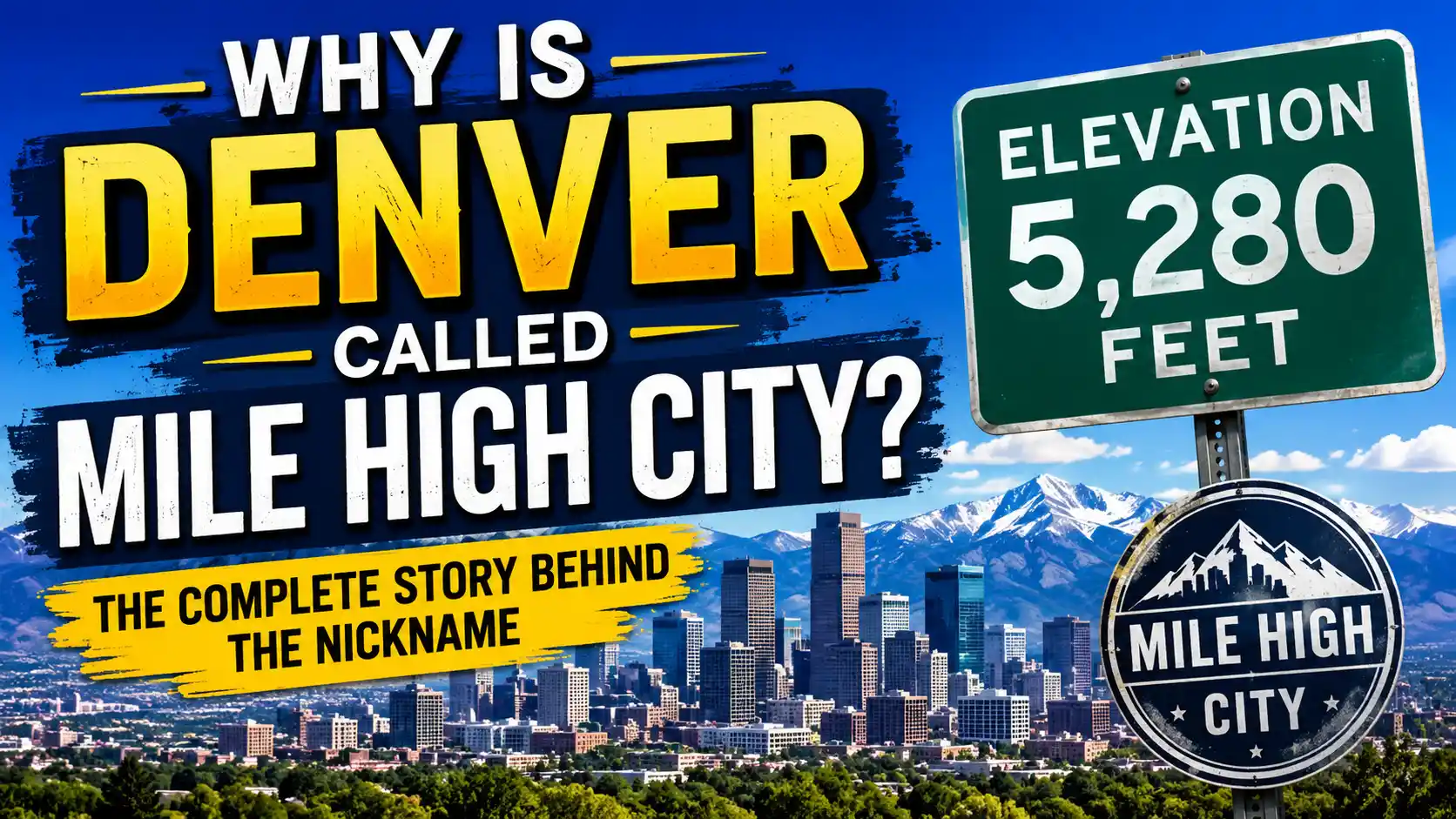
If you want to know about “Why Is Denver Called Mile High City?”?
📌 Short Answer
Denver is called the Mile High City because its official elevation is exactly 5,280 feet — one mile — above sea level. A bronze marker on the 13th step of the Colorado State Capitol commemorates this precise altitude, turning a surveyor’s measurement into a proud civic identity known around the world.
The moment you step off a plane at Denver International Airport, your lungs feel it. The air is thinner, the sky bigger, the sun brighter. This isn’t just a feeling — it’s a geographic fact. Denver, Colorado, sits exactly one mile above the sea, a lofty perch that has defined the city’s character, culture, and national brand for over a century. That’s why the world knows it as the Mile High City.
What Does “Mile High City” Mean?
The nickname is refreshingly literal. A mile equals 5,280 feet (or roughly 1,609 meters). The elevation at the Colorado State Capitol building in downtown Denver is exactly 5,280 feet above sea level. That means when you stand on the Capitol’s west steps, your feet are exactly one mile closer to the sky than if you were standing at the ocean’s edge. The phrase “Mile High City” turns that statistic into an identity — one that speaks of altitude, adventure, and a place where the mountains meet the Great Plains.
Why Is Denver Called “Mile High City”?
Denver earned this name for one simple reason: its official elevation is 5,280 feet above sea level — precisely one mile. But the story of how an altitude measurement became an internationally recognized city brand is a tale of pioneer surveyors, newspaper headlines, a capitol step marker, and decades of tourism boosterism.
Unlike nicknames rooted in mythology or marketing alone, Denver’s moniker is grounded in verifiable geography. The spot where the Colorado State Capitol stands was chosen not just for its central location but because surveyors determined it marked the 5,280-foot contour line. That lucky coincidence gave the city a slogan that no other major American metropolis could claim.
The Origin of the Nickname
Long before the “Mile High City” appeared on T-shirts and stadiums, Denver’s elevation was a topic of fascination. In 1858, during the Pike’s Peak Gold Rush, prospectors founded Denver City on the banks of Cherry Creek. They quickly realized they were far higher than the Midwestern towns they’d left behind. Early survey equipment confirmed that much of the fledgling settlement hovered right around one mile above sea level.
When Colorado became a territory in 1861 and a state in 1876, Denver boomed as a supply hub and railroad town. Civic leaders wanted to distinguish Denver from other western cities, and the “mile high” fact was a ready-made differentiator. But the nickname didn’t burst into public consciousness overnight. It simmered in newspaper prose and promotional pamphlets until the turn of the 20th century, when one fateful headline gave it permanent life.
Who Coined the Nickname?
The strongest historical evidence points to the Denver Republican newspaper. On December 1, 1901, the paper ran a story with the headline “Denver, the Mile High City.” This is the earliest known print usage of the exact phrase, according to the Denver Public Library’s Western History collection.
Whether a specific editor or reporter first penned those words is unclear — no single person is universally credited. But the paper’s usage coincided with a surge of city promotion. In 1902, the Denver Chamber of Commerce adopted the “Mile High City” language in its tourism materials, cementing the phrase as an official-sounding slogan. From that moment on, Denver was no longer just a city with high altitude; it was the Mile High City.
History Behind the Nickname
Denver’s mile-high identity is inseparable from the Colorado State Capitol. When the building was completed in 1894, workers installed a brass marker on the 13th step of the west entrance in 1909, engraved with the words “One Mile Above Sea Level.” For generations, that single step became a pilgrimage spot for tourists, newlyweds, and geography buffs.
But the story of the marker isn’t as straightforward as it seems. In 1969, a more precise survey determined that the actual one-mile line fell on the 18th step, so a second brass marker was placed there. Then, in 2003, updated geodetic technology using a more refined model of the Earth’s shape declared that the original 13th step was, in fact, closer to true 5,280 feet. A new, more exact marker was installed on the 13th step, and today you’ll see three markers on the Capitol steps, each telling a chapter of measurement history.
The nickname grew organically with Colorado’s growth. As tuberculosis patients flocked to Denver’s dry, high-altitude climate in the early 1900s, the “mile high” air was touted as a health elixir. The city’s many sanatoriums and hotels marketed the elevation as a cure, weaving the nickname deeper into the national imagination.
Timeline of the Nickname
How the Nickname Became Popular
The Mile High City nickname didn’t need a huge marketing budget at first — it sold itself. But several forces catapulted it from a local boast to a global brand.
Media Influence: The Denver Post and Rocky Mountain News constantly referenced the mile-high elevation. By the 1920s, the nickname was firmly embedded in newspaper copy and magazine travel pieces.
Tourism Influence: The Denver Convention and Visitors Bureau (now Visit Denver) adopted “The Mile High City” as its official slogan. Early promotional brochures promised cleaner air, sunny skies, and a mountain playground at exactly one mile high. That promise attracted millions of visitors over the decades.
Sports Influence: In 1968, the Denver Broncos’ new home was named Mile High Stadium — a simple, genius branding move that made the nickname an everyday phrase in sports commentary. Even when the original stadium was replaced, the name lived on: Invesco Field at Mile High, then Sports Authority Field at Mile High, and now Empower Field at Mile High. The Broncos’ thunderous crowd roar became synonymous with “Mile High magic.”
Cultural Influence: The thin air became part of local lore. Visiting teams complained about exhaustion. Baseballs at Coors Field soared farther in the thin atmosphere. Chefs adjusted recipes because water boiled at a lower temperature. All these quirks kept the city’s elevation in the national conversation.
Myths vs Facts
Is the Nickname Still Used Today?
Absolutely. The Mile High City nickname is everywhere in modern Denver. It’s on street signs, official tourism campaigns, brewpub menus, and real estate listings. You’ll hear locals say “I live in the Mile High” with a mix of pride and offhand familiarity. Far from fading, the nickname has become inseparable from the city’s DNA.
Cultural Impact of the Nickname
Local Identity: For Denverites, “Mile High” is more than a measurement — it’s a mindset. It speaks to an outdoorsy, sun-drenched, high-energy way of life that residents cherish.
Sports Teams: The Denver Broncos still play at Empower Field at Mile High, and the phrase “Mile High Salute” — a touchdown celebration — honors the city’s elevation. The Colorado Rockies play at Coors Field, where the mile-high air creates one of baseball’s most hitter-friendly environments. Even the NBA’s Denver Nuggets and NHL’s Colorado Avalanche benefit from the altitude advantage narrative.
Tourism Branding: Visit Denver proudly uses “The Mile High City” as its official designation. The logo and tagline appear on everything from convention center banners to airport terminals. The city’s 5,280-foot elevation is a key selling point in tourism marketing.
Media and Popular Culture: The nickname pops up in movies, TV shows, and songs. Denver’s craft beer scene has embraced it with names like “Mile High IPA” and “5280 Brewing.” The number 5280 is so iconic that a local magazine is called *5280*. The city’s altitude is woven into everyday conversation.
Interesting Facts About the Nickname
- The official elevation of Denver is not just a ballpark figure — it’s precisely 5,280.0 feet according to the National Geodetic Survey.
- The Denver Broncos’ Mile High Stadium, opened in 1948 as a minor league baseball park, became a football landmark and one of the loudest stadiums in the NFL.
- The 13th step marker at the Capitol is one of the most photographed spots in Colorado.
- Water boils at about 202°F (94°C) in Denver, which means pasta takes longer to cook and cake recipes often need adjustments.
- The thin air reduces aerodynamic drag but also makes long-distance running noticeably harder for visitors — elite athletes often train at altitude for this reason.
- Denver is exactly one mile high, but the city is not flat; it gradually slopes upward toward the foothills of the Rockies.
- Denver’s sister city, Brest, France, sits at sea level — a fun opposite.
- The number 5280 has become a local cultural meme, appearing in street art, craft beer names, and even a local lifestyle magazine.
- In 2015, a “Mile High Tree” — a digital holiday installation — became a downtown holiday tradition, playing on the nickname.
- The term “Mile High Club” (unrelated to the city) actually references the altitude, but Denver capitalizes on the association playfully in tourism jokes.
Other Nicknames of Denver
While the Mile High City reigns supreme, Denver has a few other nicknames worth knowing. It’s been called the Queen City of the Plains, a nod to its dominance as the economic and cultural hub of the Rocky Mountain region. Historically it was also called the Wall Street of the West due to its role in mining and energy finance. And some still affectionately refer to it as Broncos Country during football season. Discover the full stories behind these and more on our Denver Nicknames pillar page.
Beyond its gleaming skyline, the city’s energetic reputation is perfectly encapsulated in the legendary origin of why Dallas is called Triple D.
Related City Nicknames
Comparison: Mile High City vs Emerald City
🏔️ Mile High City (Denver)
Meaning: Sits exactly 5,280 feet above sea level
Origin: Geographic fact, turned civic brand by 1901 newspaper
Vibe: High-altitude, sunny, active, sporty
Climate: Dry, 300+ days of sunshine, thin air
🌲 Emerald City (Seattle)
Meaning: Surrounded by lush, year-round greenery
Origin: Winner of a 1982 civic contest, embraced by tourism
Vibe: Eco-conscious, rainy, coffee-forward, techy
Climate: Wet, temperate, famously evergreen
Both nicknames celebrate the natural environment that shapes each city’s identity. Where Denver’s elevation brings drama and thin-air adventure, Seattle’s greenery promises a lush, rain-fed vibrancy. Dive deeper into the Emerald City’s story →
Frequently Asked Questions
What does the Mile High City mean?
It means Denver’s official elevation is exactly one mile — 5,280 feet — above sea level.
Who created the nickname “Mile High City”?
It was first seen in print in the Denver Republican on December 1, 1901, and later adopted by the Denver Chamber of Commerce.
When did the nickname become popular?
It gained momentum in the early 1900s through newspaper usage and tourism advertising, then exploded with the naming of Mile High Stadium in the 1960s.
Is the Mile High City nickname official?
It is the city’s official tourism slogan and widely used by city agencies, but it has never been legally adopted as an official municipal designation.
Do locals call Denver the Mile High City?
Yes, residents use the nickname casually, and “Mile High” appears in countless local business names, festivals, and everyday references.
What is the significance of the 13th step at the Capitol?
It is marked as the exact point where the elevation reaches 5,280 feet above sea level — a physical embodiment of the Mile High City concept.
Does Denver’s altitude really affect cooking?
Yes. Water boils at about 202°F (94°C), so boiling times increase, and baked goods often need recipe adjustments for leavening and moisture.
What are other nicknames of Denver?
Other nicknames include the Queen City of the Plains, the Wall Street of the West, and Broncos Country. Read our full Denver nicknames guide for more.
Why is the Denver Broncos’ stadium named Mile High?
The original Mile High Stadium (1948) adopted the nickname, and successive venues kept “Mile High” in the name to honor the city’s elevation and fan identity.
Is Denver the only city with a one-mile elevation?
No, but it is the highest major city in the United States. Many smaller Colorado mountain towns sit far higher.
How does the altitude affect sports in Denver?
The thin air reduces oxygen for athletes, making endurance more difficult, but also decreases air resistance. Baseballs travel farther, and visiting teams often struggle with fatigue.
What does “5280” refer to in Denver?
5280 is the number of feet in a mile, and it’s used as a local shorthand in magazines, brewery names, and neighborhood branding.
Is the nickname used in music or pop culture?
Yes, it appears in songs, TV shows, and the famous “Mile High Salute” celebration. The phrase is a staple of Denver’s cultural identity.
Can you feel the altitude difference when visiting Denver?
Most visitors notice drier air, faster sunburn, and shortness of breath during physical exertion. Staying hydrated and taking it easy on the first day helps.
Explore More
Conclusion
Denver’s Mile High City nickname is that rare thing — a civic brand backed by hard geography, scientific measurement, and more than a century of public affection. From a 1901 newspaper headline to the roar of Mile High Stadium, those 5,280 feet of elevation have become a source of pride, a marketing magnet, and a daily reminder that this city sits closer to the sky. Whether you’re photographing the Capitol step, adjusting a cake recipe for altitude, or cheering on the Broncos, you’re living the truth behind one of America’s most authentic city nicknames.