
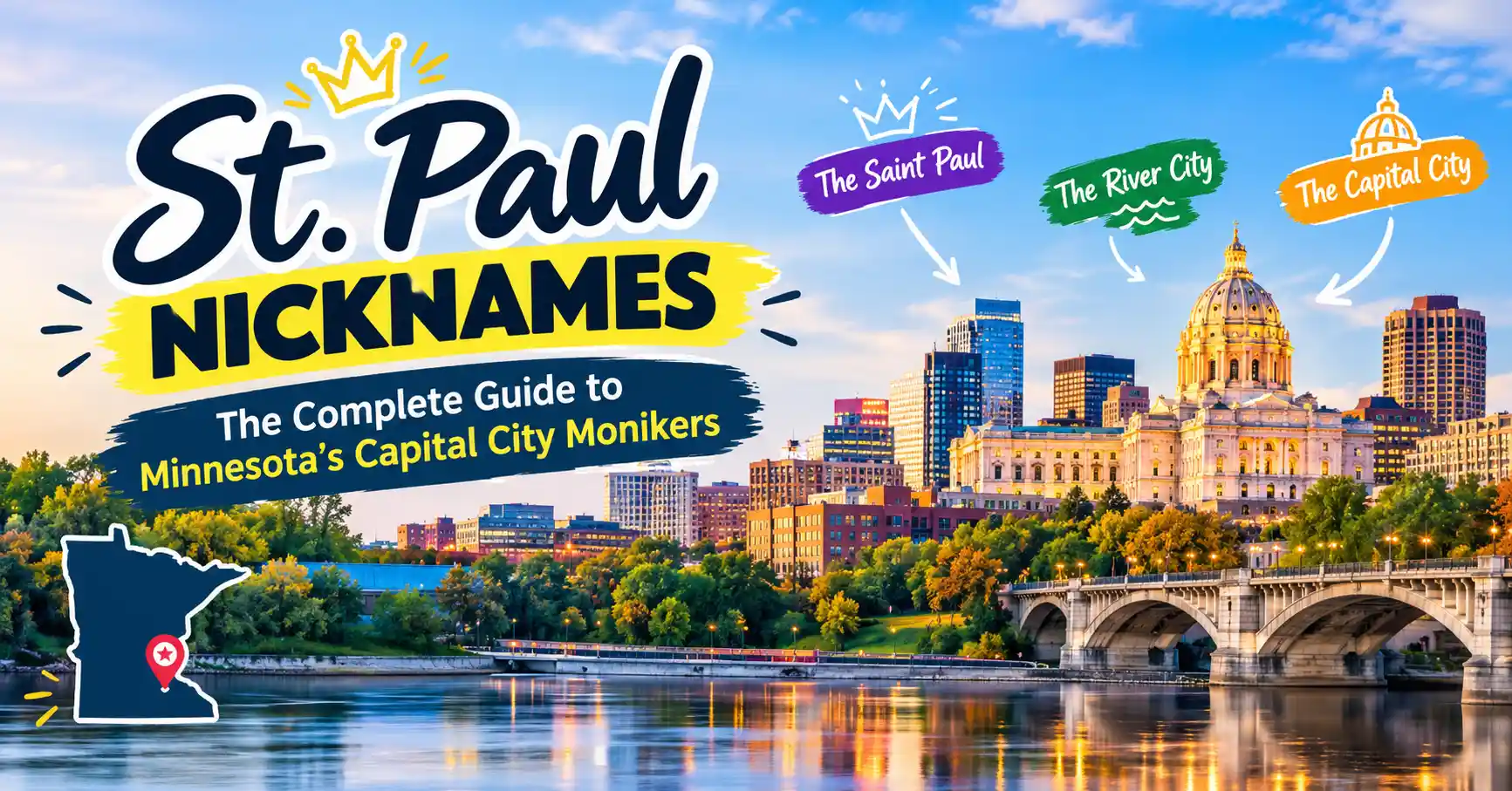
St. Paul, Minnesota, is a city rich in history, culture, and character. As the state capital and one of the famous Twin Cities, it has earned several memorable nicknames over the years. From “The Saintly City” to “Pig’s Eye,” these monikers reflect the city’s unique identity and storied past.
The St. Paul nicknames tell fascinating stories about the city’s geography, history, and cultural evolution. Understanding these nicknames provides insight into how this Midwestern capital developed from a rough frontier settlement into a thriving metropolitan center.
⭐ Quick Answer
The most famous nickname of St. Paul is “The Saintly City.” Other well-known nicknames include “Pig’s Eye,” “Twin Cities” (shared with Minneapolis), and “The Capital City.” These reflect its religious heritage, frontier history, and political significance.
📊 Quick Facts Table
🏛️ Official Nickname of St. Paul
St. Paul does not have an officially designated nickname by law or government proclamation. However, “The Saintly City” is widely recognized as the city’s most traditional and commonly used moniker. This nickname is considered historical and popularly recognized rather than official.
The name “St. Paul” itself derives from the Catholic Saint Paul the Apostle, as the city was named after the Chapel of Saint Paul, a log chapel built in 1841 by Father Lucien Galtier. The religious origins of the city’s name naturally led to the “Saintly City” nickname.
📝 What Are the Nicknames of St. Paul?
St. Paul has accumulated numerous nicknames throughout its nearly two-century history. These monikers reflect different aspects of the city’s identity—its religious roots, geographical features, historical reputation, and relationship with neighboring Minneapolis.
The St. Paul nicknames fall into several categories: religious references, geographic descriptions, historical epithets, and affectionate local terms. Each tells a unique story about how this capital city has been perceived by residents, visitors, and the nation throughout its development.
Categories of St. Paul Nicknames
Religious and Historical Nicknames
These reflect the city’s origins as a settlement named after a Catholic saint and its early reputation.
- The Saintly City
- The Holy City
- Saint Paul
Geographic and Political Nicknames
These highlight the city’s location and political significance.
- The Capital City
- Twin Cities (shared with Minneapolis)
- River City
Cultural and Colloquial Nicknames
These are informal names used by locals and in popular culture.
- Pig’s Eye
- St. Paul
- The Other Twin
📋 Complete List of St. Paul Nicknames
⭐ Most Popular Nicknames of St. Paul
Among the many nicknames associated with St. Paul, several stand out as the most recognized and frequently used. “The Saintly City” remains the most traditional and widely referenced nickname, appearing in historical documents, tourism materials, and local parlance. “Twin Cities” is arguably the most globally recognized term, though it refers to both St. Paul and Minneapolis collectively.
“Pig’s Eye” holds a special place in local lore as the city’s original informal name, while “The Capital City” serves as a straightforward descriptor of St. Paul’s political importance. These nicknames collectively paint a comprehensive picture of the city’s identity.
📚 Main Nicknames Explained
🕊️ The Saintly City
Meaning: A reference to St. Paul’s religious namesake and its reputation as a more reserved, conservative city compared to neighboring Minneapolis.
Short Origin Story: The nickname emerged in the 19th century, derived from the city’s name honoring Saint Paul the Apostle. Early settlers and visitors noted the city’s church-going culture and relatively orderly atmosphere compared to rougher frontier towns.
Historical Background: During the late 1800s, St. Paul developed a reputation for being more refined and morally upright than its rowdier neighbor, Minneapolis. This contrast reinforced the “Saintly” designation.
Modern Usage: Today, “The Saintly City” appears in tourism marketing, local media, and historical references. It remains the most iconic nickname for St. Paul.
Cultural Impact: The nickname has been embraced by locals as a point of civic pride, emphasizing St. Paul’s historical significance and cultural contributions.
Interesting Fact: Despite the “saintly” reputation, St. Paul historically had a notorious side, including a thriving gangster scene during Prohibition.
🐷 Pig’s Eye
Meaning: Named after Pierre “Pig’s Eye” Parrant, a French-Canadian fur trader and bootlegger who was one of the first permanent settlers in the area.
Short Origin Story: Before the settlement was renamed St. Paul, it was informally known as “Pig’s Eye” after Parrant, who had a distinctive eye condition that earned him the nickname “Pig’s Eye.” His tavern became a gathering place, and the settlement around it took his name.
Historical Background: In the late 1830s and early 1840s, the area was a rough frontier settlement. Father Lucien Galtier, who established the Chapel of Saint Paul, successfully lobbied to rename the settlement after the chapel, replacing the less dignified “Pig’s Eye.”
Modern Usage: “Pig’s Eye” is remembered fondly in local history. Several businesses and landmarks in St. Paul use the name, including Pig’s Eye Lake and Pig’s Eye Regional Park.
Cultural Impact: The nickname represents St. Paul’s frontier origins and serves as a reminder of the city’s humble beginnings.
Interesting Fact: Pierre Parrant was eventually forced out of the settlement and died in obscurity, but his nickname lives on in St. Paul’s history.
🏙️ Twin Cities
Meaning: A collective designation for the Minneapolis-St. Paul metropolitan area, referring to the two cities’ proximity and interconnectedness.
Short Origin Story: The term “Twin Cities” emerged in the late 19th century as Minneapolis and St. Paul grew rapidly and became economically and culturally linked despite their rivalry.
Historical Background: The two cities are separated by the Mississippi River and have distinct identities, but their close proximity led to the “Twin Cities” designation becoming standard by the 1880s.
Modern Usage: “Twin Cities” is now the primary way to refer to the entire metropolitan region. St. Paul is often called “the other twin” or “the quieter twin.”
Cultural Impact: The nickname emphasizes the unique relationship between the two cities, which compete in sports and business but cooperate regionally.
Interesting Fact: St. Paul is actually older than Minneapolis, having been established as a settlement before its more populous neighbor.
🏛️ The Capital City
Meaning: A straightforward reference to St. Paul’s status as the capital of Minnesota.
Short Origin Story: This nickname became common after Minnesota achieved statehood in 1858, with St. Paul designated as the capital.
Historical Background: St. Paul’s selection as capital was contested, with other cities like St. Anthony (now part of Minneapolis) vying for the honor. St. Paul’s central location and established infrastructure won out.
Modern Usage: “The Capital City” is used in media, tourism, and official contexts to distinguish St. Paul from Minneapolis.
Cultural Impact: The nickname highlights St. Paul’s political importance and its role as the seat of Minnesota’s government.
Interesting Fact: The Minnesota State Capitol building in St. Paul is one of the most recognized landmarks in the state, featuring the largest unsupported marble dome in the world.
🌊 River City
Meaning: A reference to St. Paul’s location on the Mississippi River, which was crucial to its development as a transportation and trade hub.
Short Origin Story: As a major river port in the 19th century, St. Paul earned the “River City” designation due to its economic reliance on the Mississippi.
Historical Background: Steamboats and river trade were vital to St. Paul’s early economy, connecting it to markets in the South and East.
Modern Usage: “River City” is less common today but still appears in local references and historical contexts.
Cultural Impact: The nickname underscores the Mississippi River’s role in St. Paul’s growth and identity.
Interesting Fact: St. Paul was the northernmost navigable port on the Mississippi River for large steamboats.
🏆 Which Nickname Is Most Famous?
“The Saintly City” is widely considered St. Paul’s most famous nickname. Its fame stems from several factors:
- Historical Depth: The nickname has been in use for over a century and is deeply embedded in local culture.
- Uniqueness: Unlike “Twin Cities,” which is shared with Minneapolis, “The Saintly City” is specific to St. Paul.
- Civic Pride: Locals embrace the nickname as a reflection of the city’s character and heritage.
- Media Presence: The nickname frequently appears in news articles, tourism materials, and historical documentation.
While “Twin Cities” is more globally recognized, it refers to the metropolitan area as a whole rather than St. Paul specifically. “Pig’s Eye” is famous regionally but is more of a historical curiosity than a current nickname.
🔍 How St. Paul Got Its Nicknames
St. Paul’s nicknames developed through a combination of historical events, geographical features, and cultural perceptions. The city’s religious name, derived from the Chapel of Saint Paul, naturally led to “The Saintly City.” Its frontier origins and colorful characters gave rise to “Pig’s Eye.” The city’s relationship with Minneapolis created “Twin Cities,” while its political role inspired “The Capital City.”
Each nickname represents a different chapter in St. Paul’s story, from rough frontier settlement to dignified state capital. Together, they form a rich tapestry of identity that continues to evolve.
📝 Other Nicknames at a Glance
- The Holy City – A religious variation of “The Saintly City”
- St. Paul – The formal name, often used to distinguish from Minneapolis
- The Other Twin – An affectionate acknowledgment of Minneapolis’s larger size
- The Quaint Twin – Emphasizing St. Paul’s more historic, relaxed atmosphere
- Minnesota’s Capital – A formal descriptor
- The North Star City – A reference to Minnesota’s state motto, “L’Étoile du Nord” (The Star of the North)
🎉 Fun Facts About St. Paul
- Older Than Minneapolis: St. Paul was established as a settlement in 1841, predating Minneapolis’s founding.
- Winter Carnival: St. Paul hosts the annual St. Paul Winter Carnival, one of the oldest winter festivals in the United States, dating back to 1886.
- F. Scott Fitzgerald: The famous author was born in St. Paul, and the city influenced many of his works.
- Gangster History: During Prohibition, St. Paul was a haven for gangsters like John Dillinger and Ma Barker.
- Mississippi River: The city sits on the Mississippi River, which serves as the border between St. Paul and Minneapolis.
- State Capitol: The Minnesota State Capitol features the largest unsupported marble dome in the world.
- Science Museum: The Science Museum of Minnesota is one of the most visited museums in the state.
- Cathedral: The Cathedral of Saint Paul is one of the most prominent religious buildings in the Midwest.
- Rice Park: This historic park in downtown St. Paul is surrounded by landmarks like the Ordway Center and Landmark Center.
- Hmong Population: St. Paul has one of the largest Hmong populations in the United States, contributing to its diverse cultural landscape.
🗺️ Famous Attractions in St. Paul
St. Paul offers numerous attractions that reflect its history and culture:
- Minnesota State Capitol: A stunning example of Renaissance Revival architecture.
- Cathedral of Saint Paul: A magnificent cathedral overlooking the city.
- Science Museum of Minnesota: Featuring interactive exhibits and an Omnitheater.
- Como Park Zoo and Conservatory: A free zoo and botanical garden.
- Landmark Center: A historic building housing cultural organizations.
- Ordway Center for the Performing Arts: A premier venue for theater and music.
- Summit Avenue: A historic street lined with Victorian mansions.
- Fort Snelling: A historic military fort at the confluence of the Mississippi and Minnesota Rivers.
- Harriet Island Regional Park: Offering river views and recreational activities.
- Grand Avenue: A vibrant shopping and dining district.
⚖️ Nickname Comparison: St. Paul vs. Minneapolis
🏙️ St. Paul vs. Minneapolis Nicknames
🕊️ St. Paul
- ✨ The Saintly City
- ✨ Pig’s Eye
- ✨ The Capital City
- ✨ The Other Twin
- ✨ River City
🌊 Minneapolis
- ✨ City of Lakes
- ✨ Mill City
- ✨ Twin Cities
- ✨ The Mini Apple
- ✨ Flour City
While both cities share the “Twin Cities” designation, their individual nicknames reflect distinct identities. St. Paul emphasizes its historical and religious roots, while Minneapolis highlights its lakes and milling heritage. Together, they form one of America’s most unique metropolitan partnerships.
For more city nicknames, explore our guides on Chicago Nicknames and New York City Nicknames.
🔗 Related Cities and Their Nicknames
🌊 Minneapolis Nicknames
Explore the nicknames of St. Paul’s famous twin, including “City of Lakes” and “Mill City.”
🏙️ Illinois City Nicknames
Discover nicknames for cities across Illinois, from Chicago to Springfield.
🇺🇸 USA City Nicknames
Browse our comprehensive collection of American city nicknames.
🔗 Related City Nicknames
Find more city nickname guides for major American cities.
❓ Frequently Asked Questions
What is the official nickname of St. Paul?
St. Paul does not have an officially designated nickname. However, “The Saintly City” is the most widely recognized and traditionally used nickname for the city.
Why is St. Paul called “The Saintly City”?
The nickname derives from the city’s name, which honors Saint Paul the Apostle. The “Saintly” designation also reflects the city’s historical reputation for being more reserved and religious than neighboring Minneapolis.
Who gave St. Paul its nickname “Pig’s Eye”?
The nickname “Pig’s Eye” came from Pierre “Pig’s Eye” Parrant, an early settler and bootlegger who established a tavern in the area. The settlement was informally known by his nickname before being renamed St. Paul.
When did “Twin Cities” become popular?
The “Twin Cities” designation became popular in the late 19th century as Minneapolis and St. Paul grew and became economically interconnected.
What are other nicknames for St. Paul?
Other nicknames include “Pig’s Eye,” “Twin Cities,” “The Capital City,” “River City,” “The Holy City,” and “The Other Twin.”
🎬 Conclusion
St. Paul’s nicknames offer a fascinating window into the city’s rich history and evolving identity. From its frontier days as “Pig’s Eye” to its dignified status as “The Saintly City,” each nickname captures a different era and aspect of this remarkable capital. Whether you call it “The Capital City,” “Twin Cities,” or simply “St. Paul,” this Minnesota gem continues to earn its place among America’s most storied cities.
For more information about St. Paul’s history and attractions, visit the official Visit Saint Paul website.