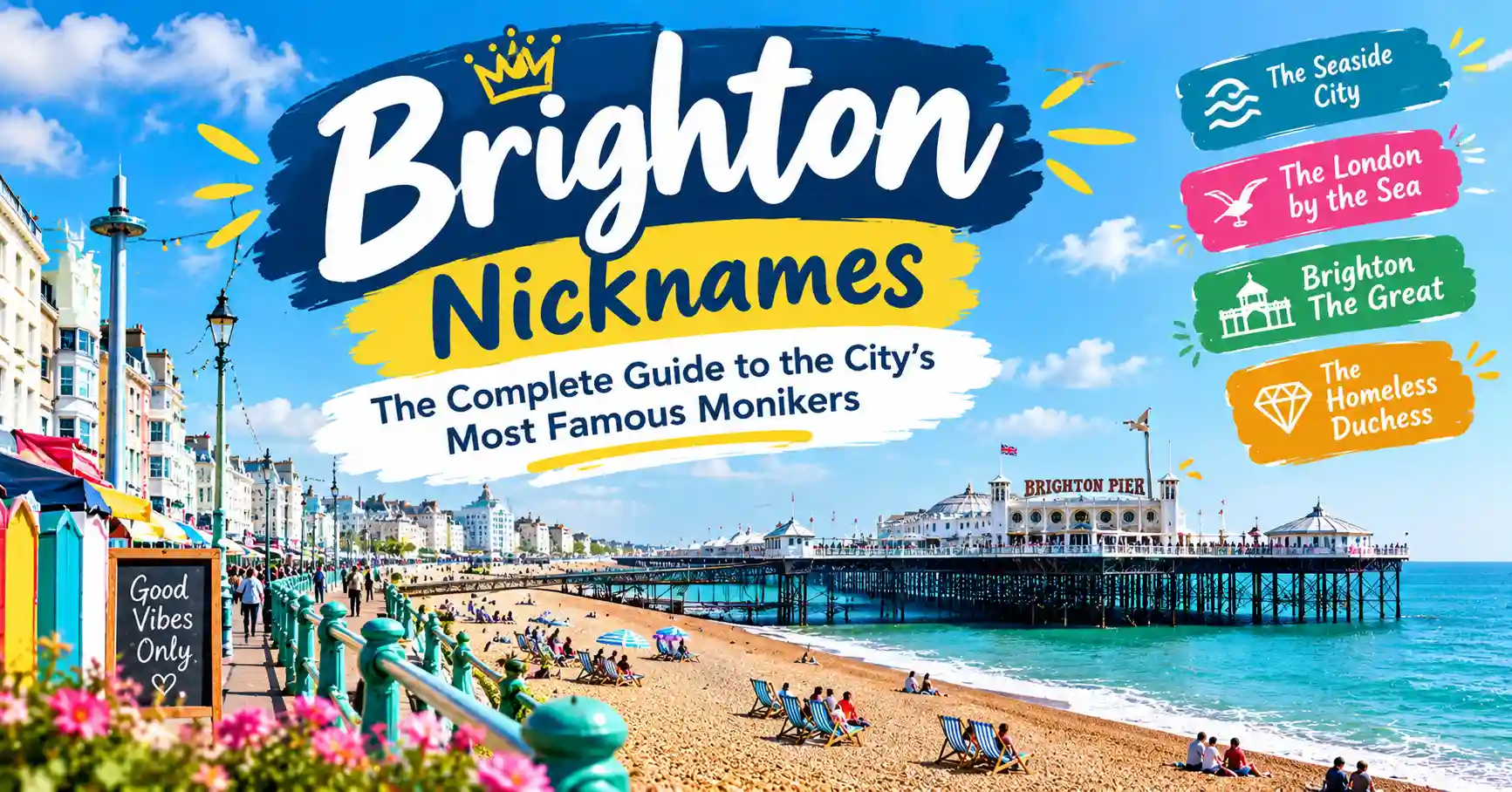
Brighton, the vibrant seaside city on England’s southern coast, has earned a remarkable collection of nicknames throughout its storied history. From “London-by-the-Sea” to “The Gay Capital of Britain,” these monikers capture the unique spirit, culture, and character that make Brighton one of the UK’s most beloved destinations. Understanding Brighton nicknames reveals the city’s evolution from a modest fishing village to a world-renowned seaside resort and cultural hub.
⚡ What Is Brighton’s Most Famous Nickname?
The most famous nickname for Brighton is “London-by-the-Sea” (or “London on Sea”), reflecting its popularity as a seaside escape for Londoners. Other well-known nicknames include “The Gay Capital of Britain” for its LGBTQ+ community, “Skintown” for its vibrant nightlife, and “The Queen of Watering Places” for its Victorian-era prestige as a premier resort destination.
📊 Quick Facts About Brighton
🏷️ Official Nickname of Brighton
Brighton does not have an officially designated nickname granted by any governing authority. However, “London-by-the-Sea” is the most commonly recognized and historically significant nickname associated with the city. This moniker emerged organically during the 18th and 19th centuries when Brighton became the preferred seaside destination for London’s elite and middle classes.
The nickname “The Queen of Watering Places” holds semi-official status, having been popularized during the Victorian era when Brighton was considered the premier seaside resort in England. While not formally adopted by any official body, it remains a historical designation that captures Brighton’s former prestige.
Other nicknames like “The Gay Capital of Britain” and “Skintown” are entirely unofficial but widely recognized in contemporary culture, reflecting modern aspects of Brighton’s identity rather than historical designations.
🌊 What Are the Nicknames of Brighton?
Brighton nicknames fall into several distinct categories, each reflecting different aspects of the city’s personality and history. Understanding these categories helps explain why this seaside city has accumulated such a diverse collection of monikers over the centuries.
Geographic and Location-Based Nicknames emphasize Brighton’s relationship with London and its coastal position. These names highlight the city’s role as a seaside escape for urban dwellers.
Cultural and Social Nicknames reflect Brighton’s progressive reputation, vibrant arts scene, and significant LGBTQ+ community. These monikers capture the city’s liberal character and creative energy.
Historical and Victorian Nicknames date back to Brighton’s heyday as a fashionable resort destination. These names evoke the elegance and prestige of the Regency and Victorian eras.
Modern and Colloquial Nicknames represent contemporary Brighton culture, including its nightlife scene and popular perception among younger generations.
📋 Complete List of Brighton Nicknames
⭐ Most Popular Brighton Nicknames
The most recognized Brighton nicknames have evolved over time, with some dating back centuries while others emerged in recent decades. “London-by-the-Sea” remains the most enduring and widely used nickname, appearing in tourism materials, news articles, and everyday conversation. This nickname perfectly encapsulates Brighton’s role as the capital’s seaside playground.
“The Gay Capital of Britain” has become increasingly prominent since the late 20th century, reflecting Brighton’s status as the UK’s most LGBTQ+-friendly city. This nickname carries significant cultural weight and is embraced by both residents and visitors.
“Skintown” represents a more contemporary nickname, popular among younger generations and those familiar with Brighton’s legendary nightlife. While less formal than other nicknames, it captures the city’s reputation for hedonistic entertainment.
🔍 Main Brighton Nicknames Explained
London-by-the-Sea
Meaning: A seaside destination that functions as an extension of London, offering coastal recreation with easy access to the capital.
Short Origin Story: When the Prince Regent (later King George IV) made Brighton his favored retreat in the late 18th century, fashionable London society followed. The arrival of railway connections in 1841 made day trips and weekend getaways accessible to London’s growing middle class, cementing Brighton’s identity as London’s beach.
Historical Background: Brighton’s transformation from fishing village to fashionable resort began when Dr. Richard Russell promoted seawater’s health benefits in the 1750s. Royal patronage accelerated this growth, and by the Victorian era, Brighton had become the most popular seaside destination for Londoners seeking escape from urban life.
Modern Usage: Today, “London-by-the-Sea” appears frequently in travel writing, tourism marketing, and news coverage of Brighton. The nickname is used affectionately and descriptively, acknowledging both Brighton’s independence and its close relationship with the capital.
Cultural Impact: The nickname has shaped Brighton’s identity as a cosmopolitan, sophisticated destination rather than a traditional British seaside town. It suggests urban amenities combined with coastal charm.
Interesting Fact: The phrase has inspired similar nicknames for other coastal cities worldwide, including “London by the Sea” references for various British seaside towns.
The Gay Capital of Britain
Meaning: Recognition of Brighton’s status as the UK’s most prominent LGBTQ+-friendly city.
Short Origin Story: Brighton’s tolerant atmosphere developed over decades, rooted in its history as a place where people could escape conventional social constraints. The city’s LGBTQ+ community grew significantly after World War II, and the first Brighton Pride event was held in 1973.
Historical Background: Unlike many British cities where LGBTQ+ venues operated discreetly, Brighton developed an openly visible gay scene from the mid-20th century. This openness attracted LGBTQ+ people from across the UK, creating a vibrant community that has profoundly influenced the city’s culture.
Modern Usage: The nickname is used proudly by residents, businesses, and tourism authorities. Brighton Pride, held annually since 1991 (with earlier iterations), attracts hundreds of thousands of visitors and is one of the UK’s largest Pride events.
Cultural Impact: Brighton’s LGBTQ+ identity has shaped its arts scene, nightlife, politics, and social character. The city consistently ranks as the UK’s most LGBTQ+-friendly destination in surveys.
Interesting Fact: Brighton & Hove City Council was among the first UK councils to formally recognize same-sex partnerships and has a long history of supporting LGBTQ+ rights.
Skintown
Meaning: A playful reference to Brighton’s reputation for partying, nightlife, and hedonistic pleasures.
Short Origin Story: “Skintown” emerged from Brighton’s club culture, particularly the rave and dance music scenes of the 1990s and 2000s. The nickname references the experience of spending all one’s money on a night out in the city.
Historical Background: Brighton has long been associated with entertainment and pleasure-seeking, from Regency-era gambling to Victorian music halls to modern nightclubs. The city’s compact center, numerous venues, and permissive atmosphere created ideal conditions for a vibrant nightlife scene.
Modern Usage: “Skintown” is used informally, often humorously, by locals and visitors describing the Brighton party experience. It appears in social media, music, and casual conversation rather than official contexts.
Cultural Impact: The nickname captures Brighton’s reputation as a city where people come to let loose and have fun, contributing to its identity as a youthful, energetic destination.
Interesting Fact: Brighton has been called the “clubbing capital of the South” and its nightlife scene is estimated to contribute significantly to the local economy.
The Queen of Watering Places
Meaning: The premier seaside resort destination, “watering place” being an archaic term for spa towns and coastal resorts.
Short Origin Story: This nickname emerged during the Victorian era when Brighton was considered the finest of England’s seaside resorts. “Watering places” referred to destinations where people went to “take the waters” for health benefits.
Historical Background: In the 18th and 19th centuries, sea bathing and drinking seawater were believed to have curative properties. Brighton’s proximity to London, royal patronage, and excellent facilities made it the most prestigious “watering place” in Britain.
Modern Usage: The nickname is now largely historical, appearing in heritage materials and historical accounts of Brighton’s Victorian heyday.
Cultural Impact: The nickname reflects Brighton’s role in pioneering the British seaside resort tradition and establishing patterns of tourism that spread to other coastal towns.
Interesting Fact: Brighton’s Royal Pavilion, built for the Prince Regent, was so extravagant that it helped establish the city’s reputation for excess and luxury.
🏆 Which Brighton Nickname Is Most Famous?
“London-by-the-Sea” is undoubtedly Brighton’s most famous nickname. This moniker appears most frequently in tourism materials, news coverage, and popular usage. Its fame stems from several factors:
Historical Depth: The nickname has been in use for over two centuries, giving it deep roots in Brighton’s identity.
Accuracy: It accurately describes Brighton’s primary function as a seaside destination for London residents and its cultural connections to the capital.
Accessibility: The nickname is immediately understandable to anyone familiar with both London and Brighton, requiring no explanation.
Official Usage: Tourism authorities, local government, and businesses regularly use “London-by-the-Sea” in promotional materials, reinforcing its prominence.
While “The Gay Capital of Britain” has become increasingly famous and carries significant cultural weight, “London-by-the-Sea” remains the most universally recognized Brighton nickname.
📜 How Brighton Got Its Nicknames
Brighton’s nicknames emerged from the city’s unique historical trajectory as a seaside resort that became intimately connected with London. The original settlement, called Brighthelmstone, was a modest fishing village until the mid-18th century when Dr. Richard Russell began promoting seawater’s health benefits.
The transformation began when wealthy Londoners started visiting for health purposes, and accelerated dramatically when the Prince Regent chose Brighton as his preferred retreat in the 1780s. Royal patronage made Brighton fashionable, and the town rapidly developed into a sophisticated resort with grand architecture, entertainment venues, and excellent facilities.
The railway arrived in 1841, making Brighton accessible to London’s growing middle class. Day trips and weekend getaways became affordable for ordinary people, and Brighton’s identity as “London-by-the-Sea” was firmly established.
Throughout the 20th century, Brighton continued to evolve. The city developed a reputation for tolerance and diversity, attracting artists, writers, and non-conformists. The LGBTQ+ community grew and became increasingly visible, eventually earning Brighton its “Gay Capital” nickname.
The nightlife scene, particularly from the 1980s onwards, created the conditions for nicknames like “Skintown.” More recently, Brighton’s growing tech sector has led to “Silicon Beach” comparisons.
📝 Other Brighton Nicknames at a Glance
- Doctor Brighton – References the city’s historical role as a health destination where sea bathing was prescribed as medicine
- Brighton-les-Bains – A Francophile nickname comparing Brighton to continental spa towns like Aix-les-Bains
- The City of Sin – A media-created nickname referencing the city’s reputation for hedonism and party culture
- Silicon Beach – A modern nickname reflecting Brighton’s growing technology and startup sector
- The Queen of Watering Places – A Victorian-era nickname celebrating Brighton’s status as England’s premier seaside resort
- Brighthelmstone – The original name of the settlement, sometimes used nostalgically or historically
🎉 Fun Facts About Brighton
- The Royal Pavilion’s Indian Architecture: Brighton’s most iconic building, the Royal Pavilion, was designed with Indian and Chinese architectural influences, making it unique among British royal residences.
- The Oldest Working Pier: Brighton Palace Pier, opened in 1899, is one of the last remaining Victorian pleasure piers in Britain and remains a popular attraction.
- Volks Railway: Brighton’s Volk’s Electric Railway, opened in 1883, is the world’s oldest operating electric railway.
- Pride Attendance: Brighton Pride is one of the UK’s largest Pride events, attracting over 300,000 attendees in some years.
- Seagull Reputation: Brighton’s seagulls are notorious for stealing food from tourists, a phenomenon that has become part of the city’s quirky identity.
- The Lanes: Brighton’s famous shopping district, The Lanes, originated as a fishing village with narrow streets that remain largely unchanged in layout.
- Naked Bike Ride: Brighton hosts an annual Naked Bike Ride, reflecting the city’s liberal and environmentally-conscious character.
- First Cinema: The Duke of York’s Picture House, opened in 1910, is one of the oldest continuously operating cinemas in the UK.
- University Impact: The University of Sussex and University of Brighton contribute to the city’s young, progressive atmosphere and vibrant arts scene.
- Beach Composition: Brighton’s beach is shingle (pebbles) rather than sand, a characteristic that has shaped its development and atmosphere.
🎡 Famous Attractions in Brighton
Brighton offers numerous attractions that embody its unique character:
Brighton Palace Pier – The iconic Victorian pier features amusement rides, arcades, and stunning sea views, remaining the city’s most visited attraction.
Royal Pavilion – This extravagant former royal residence showcases exotic architecture and offers a glimpse into Regency-era luxury.
Brighton Beach – The famous pebble beach stretches along the coast, lined with bars, restaurants, and entertainment venues.
The Lanes – A maze of narrow streets filled with independent shops, jewelry stores, and historic pubs.
North Laine – A bohemian shopping district known for vintage stores, independent boutiques, and vibrant street art.
Brighton i360 – A modern observation tower offering panoramic views of the city and coast.
Sea Life Brighton – The world’s oldest operating aquarium, opened in 1872.
Preston Park – A large public park hosting events including Brighton Pride and various festivals.
🔄 Nickname Comparison: Brighton vs Blackpool
Both Brighton and Blackpool are England’s most famous seaside resorts, but their nicknames reflect different characters. While Brighton’s “London-by-the-Sea” emphasizes sophistication and metropolitan connections, Blackpool’s “Vegas of the North” celebrates its entertainment heritage and working-class appeal.
🏙️ Related Cities and Their Nicknames
🇬🇧 London Nicknames
The Big Smoke, The Old Smoke, Londinium
🎵 Manchester Nicknames
Madchester, Cottonopolis, Mancunian
⚓ Liverpool Nicknames
The Pool, Scouse City, Capital of Pop
🇬🇧 UK City Nicknames
Complete guide to British city monikers
🇺🇸 USA City Nicknames
From the Big Apple to Sin City
❓ Frequently Asked Questions About Brighton Nicknames
What is the official nickname of Brighton?
Brighton does not have an officially designated nickname. However, “London-by-the-Sea” is the most widely recognized and historically significant nickname associated with the city.
Why is Brighton called London-by-the-Sea?
Brighton earned this nickname because of its historical role as the preferred seaside destination for London residents. The arrival of railway connections in 1841 made Brighton easily accessible for day trips and weekend getaways, establishing it as London’s beach.
Who gave Brighton its nickname?
No single person is credited with creating “London-by-the-Sea.” The nickname emerged organically over time as Brighton’s connection with London grew stronger through the 18th and 19th centuries.
When did the nickname become popular?
“London-by-the-Sea” became widely popular during the Victorian era when railway travel made Brighton accessible to London’s growing middle class. The nickname has remained in use ever since.
What are other nicknames of Brighton?
Other Brighton nicknames include “The Gay Capital of Britain,” “Skintown,” “The Queen of Watering Places,” “Doctor Brighton,” and “Silicon Beach.”
🎯 Conclusion
Brighton nicknames tell the story of a city that has continuously reinvented itself while maintaining a distinctive character. From its origins as a health resort that earned the nickname “Doctor Brighton” to its Victorian heyday as “The Queen of Watering Places,” and from its enduring identity as “London-by-the-Sea” to its modern recognition as “The Gay Capital of Britain,” these monikers capture different facets of this remarkable seaside city.
Whether you know it as Skintown, Silicon Beach, or simply Brighton, this vibrant city on England’s south coast remains one of the UK’s most fascinating destinations. Its nicknames reflect a place that embraces both tradition and progress, sophistication and fun, history and innovation. For those seeking to understand Brighton nicknames, the Brighton & Hove City Council offers official information about the city’s rich heritage and contemporary culture.