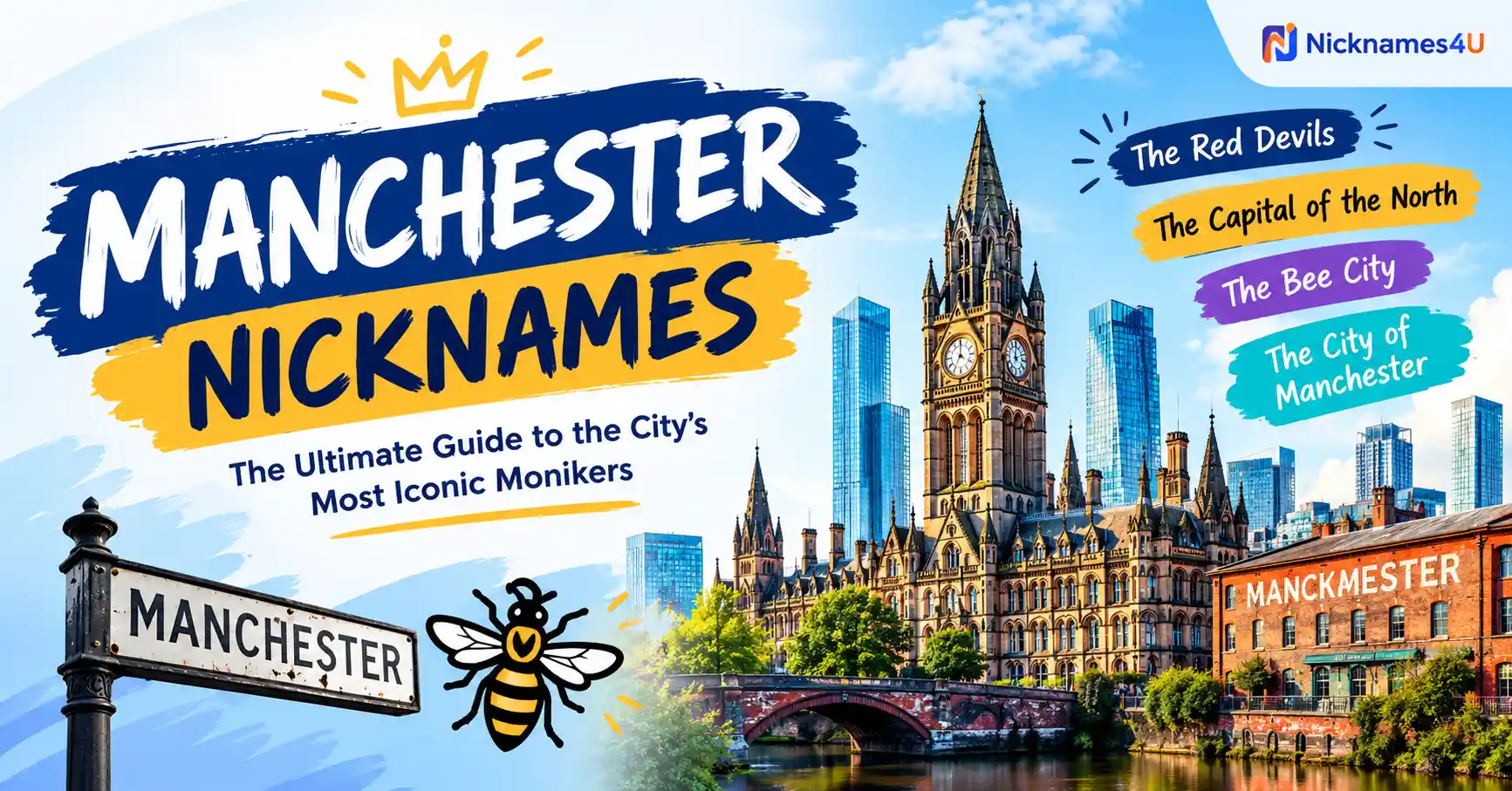
Manchester is a city in northwest England known as the birthplace of the Industrial Revolution and a global powerhouse in music, football, and culture. Over centuries, this dynamic city has earned numerous nicknames reflecting its industrial heritage, cultural impact, and unique character. From “Cottonopolis” to “Madchester,” the Manchester nicknames tell the story of a city that shaped the modern world.
Quick Answer Box
Quick Answer
The most famous nickname of Manchester is “Cottonopolis” due to its historic cotton industry dominance. Other well-known nicknames include “Madchester” for its music scene, “Warehouse City” for its industrial architecture, and “Rainy City” for its weather.
Quick Facts Table
| 📋 Detail | ℹ️ Information |
|---|---|
| City | Manchester |
| State/Country | England, United Kingdom |
| Official Nickname | None officially designated |
| Most Famous Nickname | Cottonopolis |
| Population | Approximately 550,000 (city proper) |
| Founded | Roman times (c. 79 AD as Mamucium) |
| Known For | Industrial Revolution, Football, Music, Cotton Trade |
Official Nickname of Manchester
Manchester does not have an officially designated nickname by any governing authority. However, “Cottonopolis” is widely recognized as the city’s most historically significant moniker. This nickname emerged during the 19th century when Manchester dominated the global cotton textile industry.
While “Cottonopolis” holds historical weight, modern Mancunians often embrace “Madchester” (referencing the city’s legendary music scene) and simply “MCR” in casual conversation. The lack of an official nickname reflects Manchester’s organic, grassroots identity—the city’s names were earned through cultural impact rather than official proclamation.
What Are the Nicknames of Manchester?
Manchester has accumulated numerous nicknames throughout its rich history. These names fall into several categories based on their origins:
Industrial & Economic Nicknames
- Cottonopolis
- Warehouse City
- The Workshop of the World
- King Cotton’s Capital
Cultural & Musical Nicknames
- Madchester
- Music City of the North
- The Hacienda City
Weather & Atmosphere Nicknames
- Rainy City
- The Rainy City
Football-Related Nicknames
- Football Capital of England
- The Home of Football
Regional & Locational Nicknames
- Capital of the North
- Second City of England
- The North’s Capital
Complete List of Manchester Nicknames
| 🏷️ Nickname | 📖 Meaning | 📜 Origin | ⭐ Popularity |
|---|---|---|---|
| Cottonopolis | City of Cotton | 19th century industrial era | ⭐⭐⭐⭐⭐ |
| Madchester | Manchester + Mad (crazy music scene) | Late 1980s music era | ⭐⭐⭐⭐⭐ |
| Rainy City | Reference to frequent rainfall | Weather observations, common usage | ⭐⭐⭐⭐ |
| Warehouse City | City of historic warehouses | Industrial architecture heritage | ⭐⭐⭐⭐ |
| Capital of the North | Leading city of Northern England | Regional significance | ⭐⭐⭐⭐ |
| The Workshop of the World | Industrial manufacturing hub | Industrial Revolution era | ⭐⭐⭐ |
| Second City of England | Second most important English city | 19th-20th century prominence | ⭐⭐⭐ |
| Football Capital of England | Home to major football clubs | Manchester United & Man City legacy | ⭐⭐⭐⭐ |
Most Popular Nicknames of Manchester
The most recognized Manchester nicknames are Cottonopolis, Madchester, and Rainy City. Each represents a different era and aspect of the city’s identity—its industrial might, its cultural explosion, and its famous weather. While Cottonopolis dominates historical discussions, Madchester resonates strongly with younger generations and music enthusiasts worldwide.
Main Nicknames Explained
Cottonopolis
Meaning: “Cotton City” or “City of Cotton”
Short Origin Story: The term emerged in the 19th century when Manchester became the global epicenter of cotton textile production. Writers and journalists coined the phrase to describe the city’s unprecedented industrial dominance.
Historical Background: By the 1830s, Manchester processed more cotton than any other city on Earth. Its mills, warehouses, and exchanges formed the backbone of the British Empire’s textile trade.
Modern Usage: Today, Cottonopolis appears in historical contexts, museum exhibits, and discussions of Manchester’s industrial heritage. Some local businesses have adopted the name for branding.
Cultural Impact: The nickname symbolizes Manchester’s role in creating the modern industrial world. It represents both the prosperity and the social challenges that came with rapid industrialization.
Interesting Fact: At its peak, Manchester’s cotton industry employed over 100,000 workers in more than 100 mills across the region.
Madchester
Meaning: A portmanteau of “Manchester” and “Mad,” referencing the wild music and drug culture of the era.
Short Origin Story: Journalist John Robb and Factory Records founder Tony Wilson popularized the term in the late 1980s to describe the city’s exploding music scene centered around The Haçienda nightclub.
Historical Background: Between 1988 and 1991, Manchester produced iconic bands like The Stone Roses, Happy Mondays, and Inspiral Carpets. This era merged indie rock with dance music, creating a unique sound that defined a generation.
Modern Usage: Madchester remains a nostalgic reference for music fans worldwide. The term appears in documentaries, retrospectives, and discussions of British music history.
Cultural Impact: The Madchester scene influenced global music trends, fashion, and youth culture. It put Manchester back on the cultural map after decades of post-industrial decline.
Interesting Fact: The Haçienda, the epicenter of Madchester, was funded partly by New Order’s hit song “Blue Monday,” which remains one of the best-selling 12-inch singles of all time.
Rainy City
Meaning: A direct reference to Manchester’s reputation for frequent rainfall.
Short Origin Story: This nickname developed organically over centuries as residents and visitors noted the city’s persistently damp weather.
Historical Background: Manchester’s location between the Pennines and the Irish Sea creates a climate prone to precipitation. The city receives rain on approximately 140 days per year.
Modern Usage: “Rainy City” appears in tourism materials, local humor, and even in the naming of local businesses and bands.
Cultural Impact: The nickname has become a badge of honor for Mancunians, who embrace their weather with characteristic humor and resilience.
Interesting Fact: Manchester is not actually the rainiest city in the UK—that title often goes to Cardiff or Glasgow—but its reputation persists due to frequent light drizzle rather than heavy downpours.
Warehouse City
Meaning: A reference to Manchester’s vast network of historic cotton warehouses and industrial buildings.
Short Origin Story: This nickname highlights the architectural legacy of the Industrial Revolution, when Manchester built hundreds of warehouses to store and distribute cotton goods.
Historical Background: The city’s Castlefield area and Northern Quarter contain some of the finest examples of industrial architecture in the world.
Modern Usage: “Warehouse City” is often used in heritage and tourism contexts, celebrating Manchester’s architectural significance.
Cultural Impact: Many former warehouses have been converted into apartments, offices, and cultural spaces, preserving the city’s industrial character.
Interesting Fact: Manchester’s warehouse district is considered one of the most complete surviving examples of an industrial cityscape from the 19th century.
Capital of the North
Meaning: Manchester’s claim to being the leading city of Northern England.
Short Origin Story: This nickname reflects Manchester’s economic, cultural, and political influence across northern England.
Historical Background: Throughout the 19th and 20th centuries, Manchester competed with Liverpool, Leeds, and Newcastle for regional dominance.
Modern Usage: The nickname appears frequently in media, sports commentary, and civic promotion.
Cultural Impact: It represents Manchester’s ongoing rivalry with London and its role as a counterweight to the capital’s dominance.
Interesting Fact: Manchester’s media industry, including the BBC’s northern headquarters at MediaCityUK in Salford, reinforces its status as the “Capital of the North.”
Which Nickname Is Most Famous?
“Cottonopolis” is widely considered Manchester’s most famous nickname. Its global recognition stems from the city’s unparalleled role in the Industrial Revolution and the cotton trade. While Madchester has strong cultural resonance, Cottonopolis captures Manchester’s historical significance on a worldwide scale. The nickname appears in academic texts, museum exhibitions, and international discussions of industrial heritage.
How Manchester Got Its Nicknames
Manchester’s nicknames emerged organically over centuries, reflecting the city’s evolving identity. The Industrial Revolution transformed a modest market town into the world’s first industrial city, earning names like Cottonopolis and Warehouse City.
The late 20th century brought cultural reinvention, with Madchester capturing the city’s musical explosion. Weather-related nicknames like Rainy City developed through everyday observation and local humor. Together, these names tell the story of a city that constantly reinvents itself while honoring its past.
Other Nicknames at a Glance
- MCR – Common abbreviation used by locals and in digital spaces
- The 0161 – Reference to the city’s telephone area code
- Gunchester – A controversial 1990s nickname referencing gang-related crime
- The Second City – Historical reference to Manchester’s prominence
- King Cotton’s Capital – Emphasizing the cotton trade’s dominance
- The Home of Football – Acknowledging the city’s football heritage
- The Rainy City – Variation of the weather-related nickname
Fun Facts About Manchester
- First Industrial City: Manchester is widely regarded as the world’s first industrial city, pioneering factory-based manufacturing.
- Two Football Giants: Manchester is home to two of the world’s most famous football clubs—Manchester United and Manchester City.
- Music Legends: The city produced legendary bands including The Smiths, Joy Division, Oasis, and The Stone Roses.
- Roller Skating Invention: The first practical roller skates were invented in Manchester in 1876.
- Suffragette Movement: Manchester was a key center of the women’s suffrage movement in the early 20th century.
- Atomic Theory: John Dalton developed his atomic theory while living and working in Manchester.
- First Passenger Railway: The Liverpool and Manchester Railway, opened in 1830, was the world’s first inter-city passenger railway.
- MediaCityUK: The BBC’s northern headquarters is located in Salford, part of Greater Manchester.
- Curry Mile: Manchester’s Rusholme area is famous for its “Curry Mile,” featuring numerous South Asian restaurants.
- Vimto Origins: The popular soft drink Vimto was invented in Manchester in 1908.
Famous Attractions in Manchester
Manchester offers visitors a rich blend of history, culture, and modern attractions. The Science and Industry Museum celebrates the city’s industrial heritage. Old Trafford and the Etihad Stadium draw football fans from around the world. The Northern Quarter showcases independent shops, street art, and vibrant nightlife.
John Rylands Library offers stunning neo-Gothic architecture, while the Manchester Art Gallery houses impressive collections. The People’s History Museum tells stories of democracy and social change. For music fans, the Manchester Arena and various historic venues continue the city’s musical legacy.
Nickname Comparison
⚽ Manchester vs Liverpool Nicknames
🏙️ Manchester
- Cottonopolis – Cotton industry capital
- Madchester – 1980s music revolution
- Rainy City – Famous weather
- Capital of the North – Regional leader
⚓ Liverpool
- The Pool – Shortened form
- Scouse City – Local dialect reference
- Pool of Life – Philosophical nickname
- Second City of the Empire – Historical status
Both cities share industrial heritage and fierce football rivalries, yet their nicknames reflect distinct identities.
Related Cities and Their Nicknames
🔗 Explore More City Nicknames
Frequently Asked Questions
What is the official nickname of Manchester?
Manchester has no officially designated nickname. However, “Cottonopolis” is widely recognized as its most historically significant moniker, reflecting the city’s dominance in the cotton industry during the 19th century.
Why is Manchester called Cottonopolis?
Manchester earned the nickname “Cottonopolis” because it was the global center of cotton textile production during the Industrial Revolution. The city’s mills processed more cotton than anywhere else in the world, earning it this distinctive title.
Who gave Manchester its nickname?
The nickname “Cottonopolis” emerged organically from journalists and writers in the 19th century who sought to describe Manchester’s unprecedented industrial dominance. No single person is credited with coining the term.
When did the nickname Madchester become popular?
“Madchester” became popular between 1988 and 1991, during the city’s legendary music scene. Journalist John Robb and Factory Records founder Tony Wilson helped popularize the term to describe the fusion of indie rock and dance music emanating from Manchester.
What does the nickname Rainy City mean?
“Rainy City” refers to Manchester’s reputation for frequent rainfall. The city’s location between the Pennines and the Irish Sea creates a climate prone to precipitation, with rain falling on approximately 140 days per year.
Conclusion
Manchester’s nicknames capture the essence of a city that transformed the world through industry, music, and football. From the cotton mills that earned it the title “Cottonopolis” to the legendary music scene that made it “Madchester,” these names reflect Manchester’s remarkable ability to reinvent itself while honoring its heritage.
Whether you know it as the “Rainy City” or the “Capital of the North,” Manchester remains a city of global significance and undeniable character. To explore the deeper history behind these nicknames — especially the industrial revolution that gave rise to “Cottonopolis” — see Encyclopaedia Britannica’s detailed history of Manchester, a trusted external resource for further reading.