
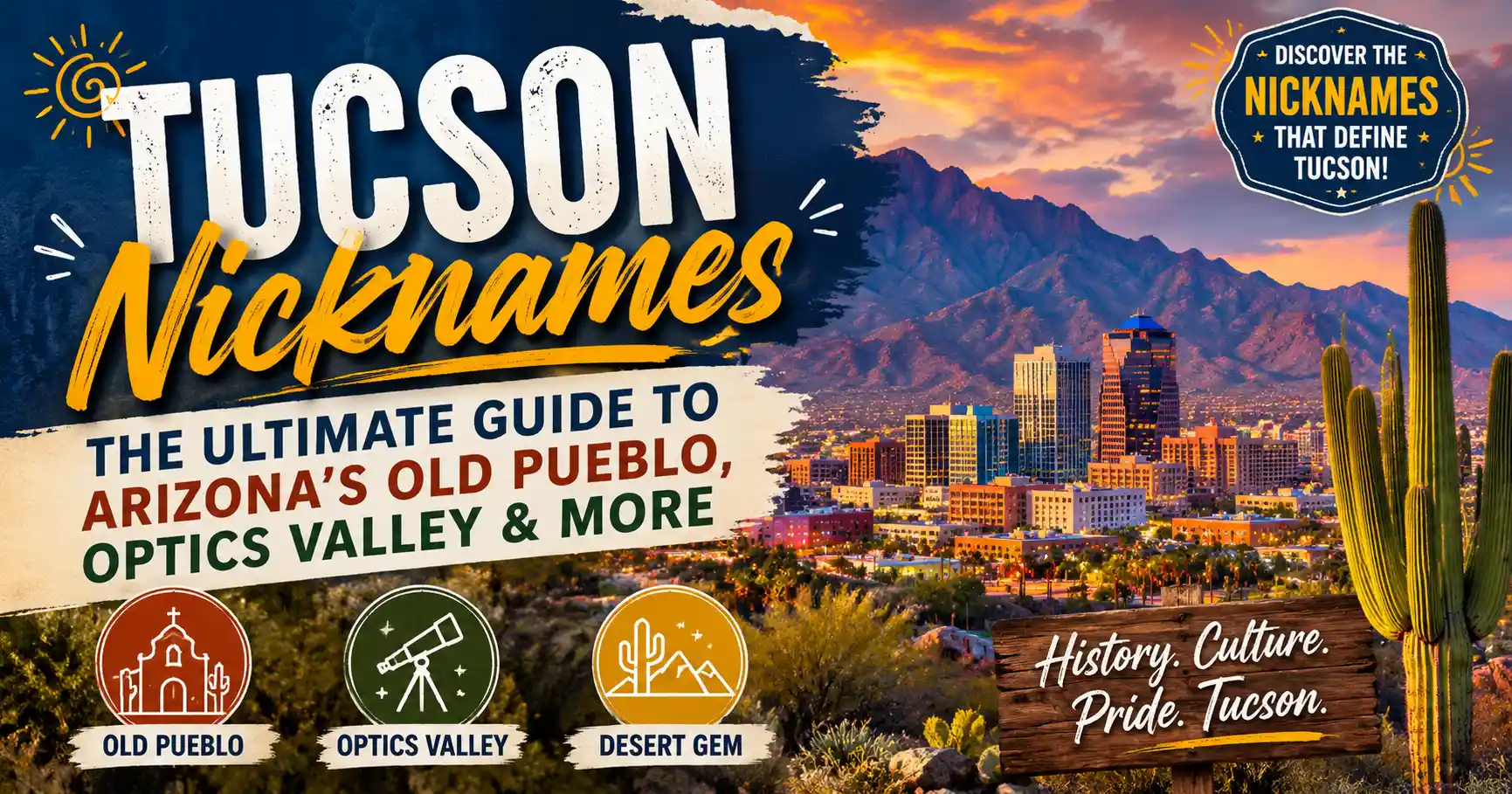
Tucson, Arizona, sits deep in the Sonoran Desert, layered with Spanish colonial history, Indigenous heritage, and a modern scientific edge. Over centuries, this sun-drenched city has collected a long list of Tucson Nicknames that reflect its adobe past, astronomy leadership, UNESCO-recognized food culture, and local pride. From “The Old Pueblo” to “Optics Valley,” each name tells a different story about the city’s identity.
The most famous nickname of Tucson is “The Old Pueblo.” Other well-known Tucson nicknames include “Optics Valley,” “Astronomy Capital of the World,” “City of Gastronomy,” “T-Town,” and the historical tourism-era “Sunshine Factory.” These names reflect Tucson’s Spanish-Mexican roots, scientific prominence, and sunny desert character.
🏜️ Official Nickname of Tucson: How Tucson Nicknames Are Born
Tucson does not have a single nickname written into city law or official municipal code. That said, “The Old Pueblo” is the most commonly recognized and culturally official nickname. It appears in local business names, newspaper headlines, event branding, music, and everyday speech.
Many of the city’s other nicknames are historical, informal, or industry-specific. Some were created by tourism boosters in the early 1900s. Others grew out of Tucson’s role as a science and technology hub. A few are pure local slang. Together, they form a nickname landscape that tells the city’s story better than any single slogan could.
🌞 What Are the Nicknames of Tucson?
Tucson’s nicknames can be grouped into a few themes: heritage, science, food, sunshine, and local shorthand. The most recognizable is “The Old Pueblo,” but several others carry weight in travel writing, academic circles, and local culture.
Below is a complete list of the city’s most common and historically meaningful nicknames.
🌟 Most Popular Nicknames of Tucson
Some Tucson nicknames are instantly recognizable to locals and visitors. Others are more specialized. The most popular names tend to emphasize Tucson’s age, sunny climate, and scientific reputation.
The six best-known nicknames are:
- The Old Pueblo
- T-Town
- Optics Valley
- Astronomy Capital of the World
- City of Gastronomy
- The Sunshine Factory
Each nickname works differently depending on the context. “The Old Pueblo” appears in daily life, while “Optics Valley” shows up more in economic development and university news.
🧭 Main Nicknames Explained
🏜️ The Old Pueblo
Meaning: Spanish-influenced “old town” or old settlement with deep Indigenous, Spanish, and Mexican roots.
Short Origin Story: Tucson is one of the oldest continually inhabited settlements in the United States. The nickname “The Old Pueblo” grew from the city’s Spanish presidio origins and its later Mexican-era adobe character.
Historical Background: The phrase began appearing in local newspapers and civic booster materials in the early 20th century. It helped distinguish Tucson from newer, fast-growing Western cities.
Modern Usage: You will see “The Old Pueblo” on local murals, business signs, event names, sports teams, and in news headlines.
Cultural Impact: The nickname is a strong source of local identity. It connects modern Tucson to its layered past without feeling like a museum label.
Interesting Fact: “The Old Pueblo” is not legally official, but it is more recognizable than many official city mottos across the United States.
🔭 Optics Valley
Meaning: A technology hub nickname for Tucson’s optics, photonics, and precision mirror industry.
Short Origin Story: The name grew around the University of Arizona’s College of Optical Sciences and the Steward Observatory Mirror Laboratory.
Historical Background: Starting in the mid-20th century, Tucson became a center for astronomical optics, defense research, and laser technology. The nickname became common in tech and economic development circles by the 1990s.
Modern Usage: “Optics Valley” appears in industry reports, university branding, and regional economic campaigns.
Cultural Impact: The nickname positions Tucson as a global high-tech player, even though the city is better known to tourists for its desert landscape.
Interesting Fact: The Richard F. Caris Mirror Lab in Tucson has cast some of the largest telescope mirrors in the world, including mirrors for the Giant Magellan Telescope.
🌌 Astronomy Capital of the World
Meaning: Recognition of Tucson as a major center for astronomical research and observation.
Short Origin Story: Kitt Peak National Observatory, the University of Arizona, and nearby Mount Lemmon made Tucson a natural astronomy hub.
Historical Background: From the 1960s onward, observatories chose Southern Arizona for its clear skies, high elevation, and dry air. Tucson’s dark-sky regulations later protected that advantage.
Modern Usage: The nickname appears in tourism materials, science writing, and local branding.
Cultural Impact: Dark-sky ordinances reduce light pollution and make Tucson a national leader in stargazing tourism.
Interesting Fact: Tucson and surrounding Pima County have lighting codes designed specifically to protect the night sky for observatories.
🌮 City of Gastronomy
Meaning: A UNESCO Creative City designation celebrating food heritage and culinary traditions.
Short Origin Story: In 2015, Tucson became the first city in the United States to be named a UNESCO City of Gastronomy.
Historical Background: The designation recognizes 4,000 years of agriculture in the Sonoran Desert, from Indigenous crops such as tepary beans, corn, and squash to Spanish and Mexican food traditions.
Modern Usage: The nickname is used by food festivals, restaurants, cultural organizations, and tourism campaigns.
Cultural Impact: The City of Gastronomy label helps preserve heirloom foods and supports local farmers, chefs, and food educators.
Interesting Fact: Tucson’s food identity includes Sonoran wheat, mesquite flour, chiles, and the famously indulgent Sonoran hot dog.
🎵 T-Town
Meaning: A short, friendly abbreviation for Tucson.
Short Origin Story: “T-Town” emerged as a natural local shorthand in the 20th century, especially in music, sports, and casual conversation.
Historical Background: The nickname became popular in local radio, car culture, and social scenes. It remains common on merchandise and social media.
Modern Usage: Tucsonans use “T-Town” to signal local pride and insider familiarity.
Cultural Impact: The name keeps Tucson approachable and rooted in everyday speech.
Interesting Fact: You will often see “T-Town” on locally made shirts, stickers, and murals across the city.
☀️ The Sunshine Factory
Meaning: A historical nickname tied to Tucson’s reputation for abundant sunshine and dry air.
Short Origin Story: In the late 1800s and early 1900s, Tucson marketed itself to health seekers, especially people with respiratory illnesses.
Historical Background: Sanatoriums, dude ranches, and boarding houses advertised the “sunshine cure” and outdoor desert living. The phrase “Sunshine Factory” captured that promise.
Modern Usage: The nickname is mostly historical, though it still appears in nostalgia-focused stories about early Tucson tourism.
Cultural Impact: The sunshine-health migration helped shape Tucson’s early economy and laid the foundation for later tourism and retirement growth.
Interesting Fact: Tucson still averages well over 280 sunny days per year, making it one of the sunniest cities in the United States.
👑 Which Nickname Is Most Famous?
Without question, “The Old Pueblo” is Tucson’s most famous nickname. It is distinctive, historically rooted, and used by locals and visitors alike.
Other cities may have a “T-Town” or a “Sunshine” label, but no major American city shares “The Old Pueblo.” The nickname instantly signals Tucson’s Spanish and Mexican heritage, its desert adobe character, and its long history. It appears in local news, business names, event titles, and everyday conversation more than any other Tucson nickname.
🗺️ How Tucson Got Its Nicknames
Most Tucson Nicknames come from three deep sources: the land, the city’s history, and its modern expertise.
The Sonoran Desert provides the sunlight, dark skies, and arid beauty behind names like “The Sunshine Factory” and “Astronomy Capital of the World.” Spanish and Mexican history gives Tucson “The Old Pueblo” and its Spanish translation, “Pueblo Viejo.” The University of Arizona and the region’s tech base produced “Optics Valley.” Local speech added “T-Town,” “The Dirty T,” and “The Biggest Small Town.”
In other words, Tucson nicknames are not random. They reflect what the city has been, what it values, and how Tucsonans see themselves.
📌 Other Nicknames at a Glance
- 🌵 The Dirty T — Affectionate local slang for Tucson’s scrappier, more urban side.
- 🇲🇽 Pueblo Viejo — Spanish for “Old Pueblo,” used in cultural and heritage contexts.
- 🏘️ The Biggest Small Town — A nod to Tucson’s community feel despite its metro size.
- 📱 The 520 — A casual nickname borrowed from Tucson’s longtime area code.
- 🏜️ Sonoran Desert City — A descriptive name used in travel and outdoor writing.
- ⛰️ Chuk Shon — Not a nickname, but the original O’odham place-name root meaning “spring at the foot of the black hill.”
🎉 Fun Facts About Tucson
- Tucson is one of the oldest continually inhabited settlements in North America, with Indigenous farming in the area dating back about 4,000 years.
- The city was officially founded as a Spanish presidio on August 20, 1775.
- Tucson was the first city in the United States to be named a UNESCO City of Gastronomy.
- Saguaro National Park, split into east and west districts, protects the iconic saguaro cactus that can live over 150 years.
- The University of Arizona’s Steward Observatory Mirror Lab casts some of the world’s largest telescope mirrors.
- Tucson has strong dark-sky ordinances designed to protect observatories and the night sky.
- Mission San Xavier del Bac, known as the “White Dove of the Desert,” was founded in 1692 and remains an active parish.
- The Pima Air & Space Museum is one of the largest aerospace museums in the world.
- Tucson hosts one of the largest gem, mineral, and fossil shows on the planet.
- Mount Lemmon, just north of Tucson, offers a dramatic climb from desert to pine forest and includes one of the southernmost ski areas in the continental United States.
🏛️ Famous Attractions in Tucson
- Saguaro National Park — Iconic saguaro forests on both east and west sides of the city.
- Mission San Xavier del Bac — A stunning Spanish colonial mission south of downtown.
- Arizona-Sonora Desert Museum — A world-renowned outdoor museum, zoo, and botanical garden.
- Pima Air & Space Museum — A massive collection of aircraft and aerospace history.
- University of Arizona — Home to the Flandrau Science Center, Mirror Lab, and historic campus.
- Mount Lemmon Scenic Byway — A dramatic drive from desert floor to cool pine forest.
- Sabino Canyon — A popular destination for hiking, wildlife, and desert scenery.
- Old Tucson Studios — A famous Western movie set and attraction.
🆚 Nickname Comparison: Tucson vs Phoenix
🌵 Tucson
Most Famous Nickname: The Old Pueblo
Other Nicknames: Optics Valley, T-Town, City of Gastronomy
Vibe: Historic, scientific, culturally layered, relaxed
☀️ Phoenix
Most Famous Nickname: Valley of the Sun
Other Nicknames: The Valley, Arizona’s Urban Heart
Vibe: Fast-growing, sprawling, sunny, business-minded
Tucson’s “The Old Pueblo” emphasizes age, heritage, and adobe-rooted character. Phoenix’s “Valley of the Sun” emphasizes sunshine, growth, and metropolitan energy. Both names capture Arizona, but from completely different angles. If Tucson is the old soul, Phoenix is the ambitious newcomer.
You can learn more about Phoenix in our guide to Phoenix Nicknames.
🏙️ Related Cities and Their Nicknames
Valley of the Sun and more 🤠 Scottsdale Nicknames
The West’s Most Western Town 🏔️ Flagstaff Nicknames
High-country Arizona monikers ☀️ Yuma Nicknames
Sunniest city on Earth? 🗺️ Arizona City Nicknames
Explore the Grand Canyon State
❓ Frequently Asked Questions
What is the official nickname of Tucson?
Tucson does not have a legally official nickname. “The Old Pueblo” is the most widely recognized and culturally official nickname, but it was never adopted by formal city law.
Why is Tucson called The Old Pueblo?
Tucson is called “The Old Pueblo” because of its deep Spanish and Mexican roots, its adobe architecture, and its status as one of the oldest continually inhabited places in the United States. The name honors the city’s early presidio and pueblo-era character.
Who gave Tucson its nickname?
No single person is credited with giving Tucson the nickname “The Old Pueblo.” The phrase emerged gradually in local newspapers and civic booster materials during the early 20th century.
When did The Old Pueblo nickname become popular?
“The Old Pueblo” became popular in the early-to-mid 1900s as Tucson grew and residents wanted to preserve a connection to the city’s older Spanish and Mexican identity.
What are other nicknames of Tucson?
Other Tucson nicknames include Optics Valley, Astronomy Capital of the World, City of Gastronomy, T-Town, The Sunshine Factory, The Dirty T, Pueblo Viejo, and The Biggest Small Town.
🏁 Conclusion
Tucson Nicknames are more than playful labels — they reveal a city shaped by desert light, Spanish adobe, Indigenous agriculture, and modern science. Whether you call it The Old Pueblo, Optics Valley, the Astronomy Capital of the World, or the City of Gastronomy, Tucson wears each name with a distinct sense of place. To explore the real places behind these names, visit Visit Tucson or check official City of Tucson resources for current attractions, dining, and cultural events.